
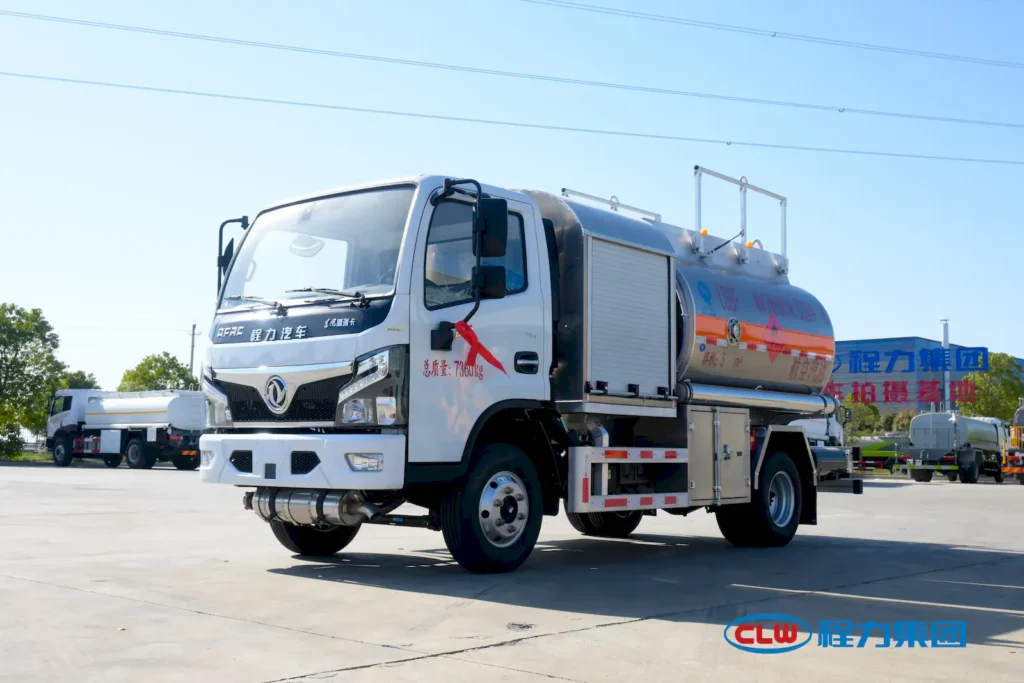
A small aircraft refueling truck is a specialized aviation ground support vehicle — not a general fuel tanker. While both transport flammable liquids, the similarities end there. An aviation refueler must deliver fuel that meets API 1581 filtration standards, prevents water and particulate contamination down to the micron level, and protects against static discharge during every transfer.
For operators serving general aviation airports, helicopter bases, flight schools, agricultural aviation, and even unmanned aerial vehicle (UAV) ground support, a 5,000-liter (5 m³) refueling truck has become the global sweet-spot capacity. It carries enough fuel to support a full day of small-aircraft operations, yet remains compact enough to navigate tight aprons, dirt airstrips, and remote helipads.
This guide walks you through everything an international buyer needs to know before sourcing a 5CBM aviation refueler from China — capacity logic, application scenarios, technical specifications, fuel compatibility, customization options, and what to look for in a supplier. The truck featured throughout this article is built with a fully customized CLW aviation upper-body structure, mounted on a customer-selectable light-duty chassis (Dongfeng, Foton, JAC, ISUZU, or other major Chinese brands available).
Why a 5,000L Small Aircraft Refueling Truck Is the Sweet Spot for General Aviation
For most general aviation operations outside major commercial airports, the choice of refueler capacity is a balance between operational autonomy and physical maneuverability. A truck that’s too large becomes a liability on small aprons; one that’s too small forces constant returns to the fuel farm.
The Capacity Math: How Many Aircraft Can One 5,000L Truck Refuel?
A 5,000-liter aviation refueler holds approximately 1,320 US gallons of fuel. To put that into operational context:
| Aircraft Type | Typical Fuel Uplift | Refuels per 5,000L Load |
|---|---|---|
| Cessna 172 (training aircraft) | 150–200 L | 25–33 aircraft |
| Robinson R44 helicopter | 180 L | 27 aircraft |
| Bell 206 helicopter | 380 L | 13 aircraft |
| Eurocopter AS350 | 540 L | 9 aircraft |
| Cessna Caravan (utility turboprop) | 1,200 L | 4 aircraft |
| King Air 350 (light business turboprop) | 1,900 L | 2 aircraft |
| Large fixed-wing UAV (military-class) | 200–500 L | 10–25 platforms |
For a typical flight school operating 6–8 trainers daily, or a tourism helicopter base running 10–15 sorties per day, a single 5,000L load covers a full operating shift without midday refilling.
Why Not Bigger (10,000L+) or Smaller (3,000L)?
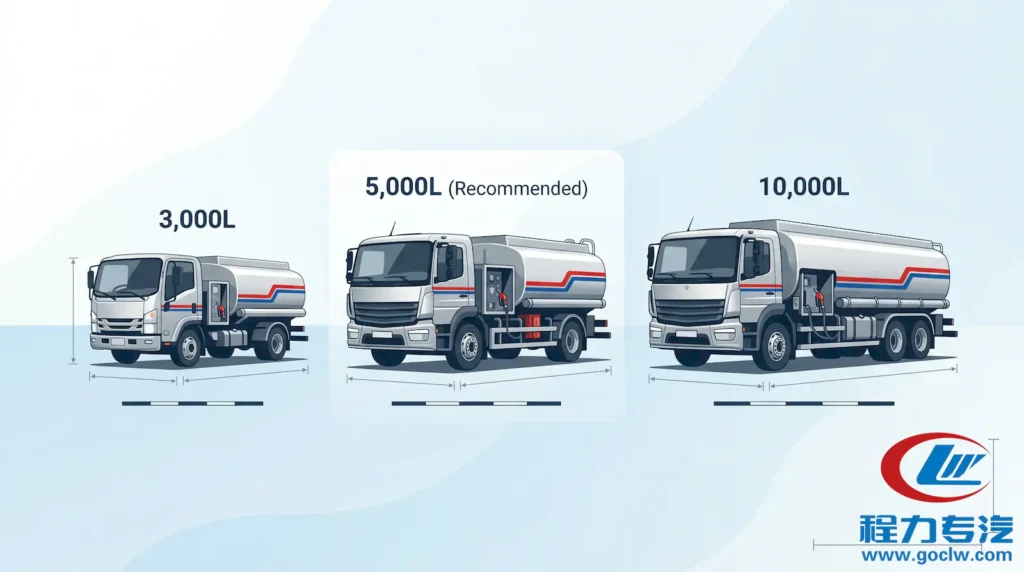
The 5,000L capacity hits a deliberate engineering sweet spot:
- Below 5,000L (3,000L): Insufficient autonomy. Operators must refill the truck two to three times during peak operations, increasing labor cost and aircraft turnaround time.
- Above 5,000L (10,000L+): Requires a larger chassis (typically 6×4 instead of 4×2), heavier gross vehicle weight, and a Class B (or equivalent) commercial driver’s license in most countries. The truck also becomes harder to position on small aprons and impossible to deploy on rough dirt airstrips.
- At 5,000L on a light-duty 4×2 chassis: Total gross weight stays around 7,360 kg, which falls within the standard light-truck driving license category in most countries — meaning your existing line technicians can operate the vehicle without special hazmat or commercial endorsements (subject to local fuel-handling certifications).
7 Application Scenarios: Beyond the Airport Tarmac
The greatest misconception about aviation refueling trucks is that they only belong at airports. A well-designed 5,000L mobile refueler is one of the most versatile pieces of aviation ground support equipment (GSE) on the market.
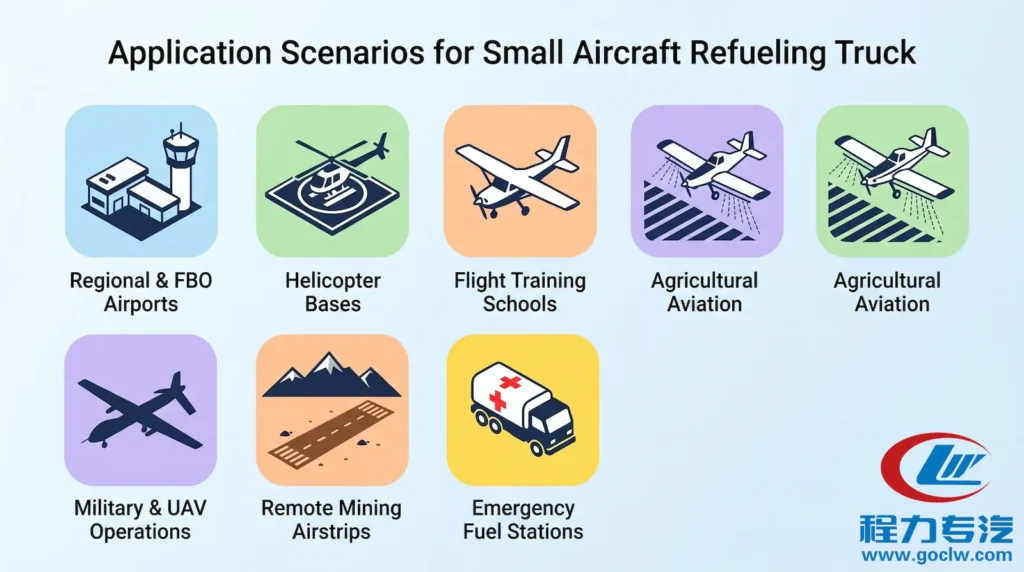
Small Regional & FBO Airports
Regional airports and Fixed Base Operators (FBOs) serving general aviation rarely have underground hydrant fuel systems. A mobile 5,000L refueler is the primary fueling method for visiting piston aircraft, light turboprops, and corporate jets. The truck’s compact wheelbase allows safe positioning under low-wing aircraft like the Cirrus SR22 or Piper Saratoga.
Helicopter Bases (EMS, Offshore, Tourism)
Helicopter Emergency Medical Services (HEMS), offshore oil-and-gas crew transport, and tourism rotorcraft operations demand fast, on-demand fueling — often in confined helipads with no fixed infrastructure. The 5,000L tank supports a full day of operations at a single helicopter base. Many of our clients operating in Southeast Asia and Africa use this exact configuration for AW139, S-76, and Bell 412 fleet support.
Flight Training Schools
A flight school running 8 Cessna 172 trainers averages 800–1,200 liters of Avgas 100LL consumption per day. A 5,000L truck stocked once per week — or supplemented with a small fuel farm — covers a full operational cycle without daily fuel-supplier visits.
Agricultural & Forestry Aviation
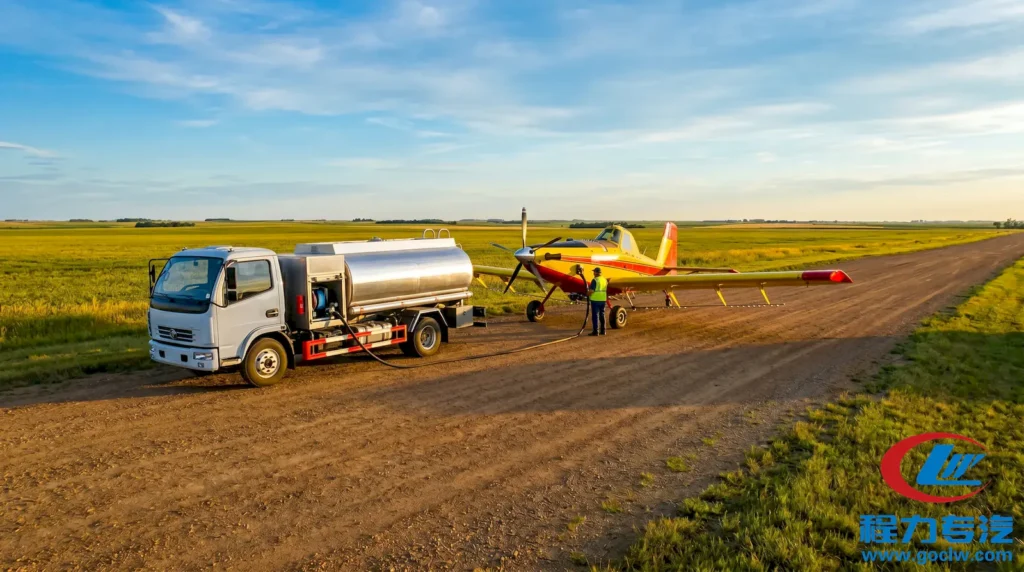
Crop-dusting aircraft and forestry water-bomber helicopters operate from temporary airstrips during seasonal campaigns. The off-road capability of a light-duty 4×2 chassis (with optional reinforced suspension) lets operators bring the fuel directly to the field instead of repositioning aircraft to a fixed base — a major cost saver during peak agricultural seasons.
Military & Surveillance UAV Operations
Large fixed-wing unmanned aerial vehicles (UAVs) used for surveillance, border patrol, and tactical reconnaissance typically run on Jet A-1 or aviation gasoline. Ground support requirements mirror those of manned light aircraft. A 5,000L mobile refueler is ideal for forward operating bases or temporary UAV deployment sites where pipeline infrastructure does not exist. With proper filtration certification, the same truck supports both manned aircraft and UAV ground stations.
Remote Mining & Oilfield Airstrips
Mining and oil-exploration operations in Central Asia, Africa, and South America frequently maintain private dirt airstrips for personnel rotation. A 5,000L aviation refueler dispatched from the main fuel depot supports both the visiting aircraft and the on-site helicopter shuttle — a dual-purpose use case that maximizes asset utilization.
Emergency Mobile Fuel Stations
In disaster-response contexts (post-earthquake aerial relief, wildfire suppression, flood evacuation), aviation operations are often the only viable transport. A pre-staged 5,000L refueler becomes a mobile emergency fuel station capable of serving aircraft, helicopters, and even ground generators — a configuration we’ve supplied to disaster-preparedness agencies in emerging markets.
Complete Technical Specifications of Our 5CBM Aviation Refueling Truck
Below are the standard specifications for the small aircraft refueling truck pictured in this article. All parameters are customizable to your operational requirements.
Chassis: Customer-Selectable Light-Duty 4×2 Platform
The featured truck in this article is mounted on a Dongfeng (DFAC) Furuika light-duty chassis. However, CLW manufactures the same 5,000L aviation upper-body on multiple Chinese light-truck platforms — buyers select the chassis brand based on local parts availability, brand preference, and after-sales network coverage in their market.
Available chassis options: Dongfeng (DFAC) / Foton / JAC / ISUZU / Sinotruk / FAW / Shacman light-duty series.
| Specification | Value |
|---|---|
| Chassis Brand | Customer-selectable (multiple Chinese brands available) |
| Drive Configuration | 4×2 (left-hand or right-hand drive available) |
| Cab Type | Flat-front, single-row (3-seat) |
| Emission Standard | Euro 3 (export-standard) / Euro 5 / Euro 6 (upgraded) |
| Transmission | 5-speed manual (automatic optional) |
| Gross Vehicle Weight | 7,360 kg |
| Curb Weight | Approx. 3,200 kg |
| Payload Capacity | Approx. 4,000 kg of aviation fuel |
| Wheelbase | 3,360 mm |
| Overall Dimensions (L×W×H) | 6,200 × 2,100 × 2,650 mm |
| Top Speed | 90 km/h |
| Tire Configuration | 6 tires (4 driving + 2 steering) |
Tank Construction & Material
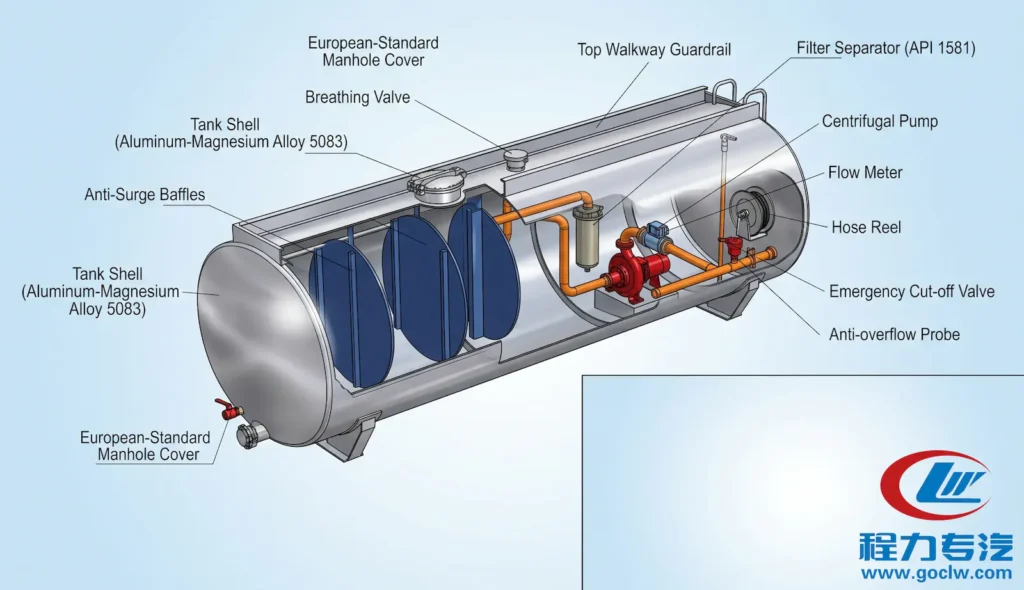
The tank is the heart of any aviation refueler. Material and construction quality directly affect fuel purity, vehicle service life, and certification eligibility. Aviation refueling trucks are never built from carbon steel — the corrosion risk and contamination potential make it unsuitable for aviation-grade fuel handling.
CLW builds every 5,000L aviation refueler with aluminum-magnesium alloy 5083 as standard, with stainless steel 304 available as an upgrade for specialized applications.
| Specification | Standard | Upgrade Option |
|---|---|---|
| Tank Material | Aluminum-magnesium alloy 5083 (aviation standard) | Stainless steel 304 |
| Tank Shape | Square-round (volume-optimized) | Elliptical (improved aerodynamics) |
| Tank Thickness | 5 mm body / 6 mm end plates | 5 mm body / 6 mm end plates |
| Effective Volume | 5,000 L (5 m³) | Customizable 4,000–6,000 L |
| Internal Baffles | 3 anti-surge baffles | 3 anti-surge baffles |
| Manhole Cover | European-standard aluminum manhole with breathing valve | Same |
| Top Walkway | Aluminum-alloy guardrail walkway, both sides | Same |
| Rear Access Ladder | Aluminum-alloy ladder | Same |
The aluminum-magnesium alloy 5083 used in our tanks is the same grade specified by IATA and major aviation fuel suppliers globally. It offers light weight, excellent corrosion resistance against aviation fuel chemistry, and zero contamination risk — protecting both the fuel and the aircraft engines downstream.
Pumping & Filtration System
This is what separates an aviation refueler from a general fuel truck. Aviation fuel must be delivered free of water, particulates, and microbial contamination — every transfer.
| Component | Specification |
|---|---|
| Fuel Pump | Aluminum-alloy centrifugal pump, 300 L/min |
| Hose Reel | 15-meter aviation-grade hose with aviation refueling nozzle |
| Filtration | 7-element filter separator (2 separator + 5 coalescer cartridges) per API 1581 standard |
| Flow Meter | 0.2-class accuracy positive-displacement flow meter |
| Working Pressure | 0.25 MPa |
| Refueling Method | Gravity refueling (standard) / Pressure refueling (optional upgrade) |
| Control System | Integrated control panel with deadman switch |
Safety & Compliance Equipment
Aviation refueling is a zero-error operation. Our 5CBM aviation refueler includes the following safety systems as standard:
- Explosion-proof electrical system throughout the fuel-handling area
- Static grounding cable with reel
- Emergency cut-off valve (bottom-loading shut-off)
- Fire extinguishers (2× dry-powder, ABC-class)
- Anti-overflow probe with audible alarm
- Reflective hazard markings per ADR Class 3 requirements
- Lockable side toolboxes for hose and nozzle storage
Avgas vs. Jet A-1: Which Aviation Fuel Does Your Operation Need?
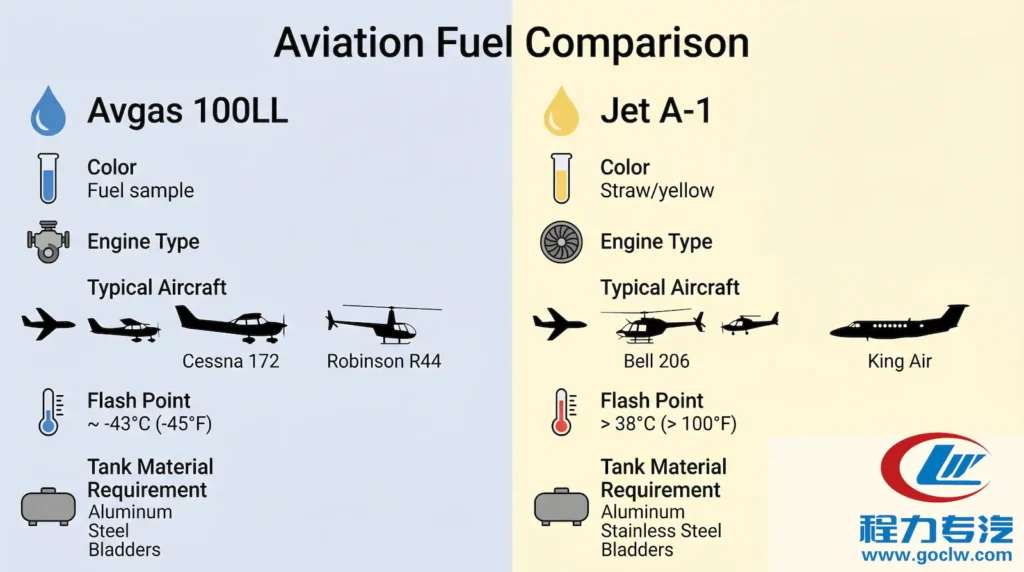
Before specifying a refueling truck, you must know exactly what fuel your aircraft fleet consumes. Mismatched fueling is one of the most serious — and most expensive — errors in general aviation.
Avgas 100LL — for Piston Engines & Light Aircraft
Aviation Gasoline (Avgas) 100LL is a low-lead, high-octane aviation fuel used exclusively in piston-engine aircraft. It powers the vast majority of training aircraft, light personal aircraft, and small agricultural planes worldwide.
- Color: Blue (international standard)
- Octane Rating: 100 (low-lead formulation)
- Typical Users: Cessna 172, Piper PA-28, Robinson R22/R44 (piston variant), Diamond DA40
- Tank Material Requirement: Aluminum alloy 5083 (our standard configuration)
- Filtration: API 1581 micronic filter-separator mandatory
Jet A-1 — for Turbines, Helicopters & Business Jets
Jet A-1 is a kerosene-based fuel used in gas-turbine engines — covering nearly all commercial jets, business jets, turboprops, and turbine helicopters.
- Color: Clear to straw-yellow
- Flash Point: Minimum 38 °C (significantly safer than Avgas)
- Typical Users: Bell 206/407/412, AW139, S-76, Cessna Caravan, King Air, Embraer Phenom
- Tank Material Requirement: Aluminum alloy 5083 or stainless steel 304
- Filtration: API 1581 with additional water-detection sensors recommended
Choosing Your Single-Fuel Configuration
Our 5,000L aviation refueler is built as a single-compartment, single-fuel tank — the industry standard for this capacity class. Trying to split a 5,000L tank into multiple compartments would reduce each compartment to an operationally inefficient size and increase contamination risk at the partition welds.
For operators serving mixed fleets (both Avgas and Jet A-1), the recommended approach is to specify dedicated single-fuel trucks — one for Avgas 100LL, one for Jet A-1 — clearly color-coded and labeled per international convention (red for Avgas, black for Jet A-1). This is safer, simpler to operate, and easier for ground crews to manage without cross-contamination risk.
Customization Options for International Buyers
Every market has different regulatory, operational, and infrastructure requirements. Over 20 years exporting to 112+ countries, CLW has built configuration flexibility into every aviation refueler we produce.
Right-Hand Drive (RHD) / Left-Hand Drive (LHD)
Both LHD and RHD versions are available from the factory. RHD configuration is supplied for markets including the United Kingdom Commonwealth countries, Japan, Indonesia, Thailand, Pakistan, Kenya, Tanzania, South Africa, and others. Confirm your driving-side requirement at the inquiry stage to avoid customs clearance issues.
Tank Material: Aluminum Alloy vs. Stainless Steel
| Material | Pros | Cons | Best For |
|---|---|---|---|
| Aluminum-Magnesium Alloy 5083 (standard) | Lightest weight, excellent corrosion resistance, IATA-preferred for aviation fuel, lower total cost | Requires specialized welding equipment for repair | Standard aviation operations — recommended for all Avgas and Jet A-1 service |
| Stainless Steel 304 (upgrade) | Highest durability, easiest to repair locally, excellent for harsh climates | Heavier (reduces effective payload by ~150 kg), higher initial cost | Operators in extremely corrosive coastal/maritime environments, or where local welding skills favor stainless steel |
For 95% of aviation refueling applications, aluminum-magnesium alloy 5083 is the optimal choice.
Pumping System: Gravity / Pump-Driven / Combined
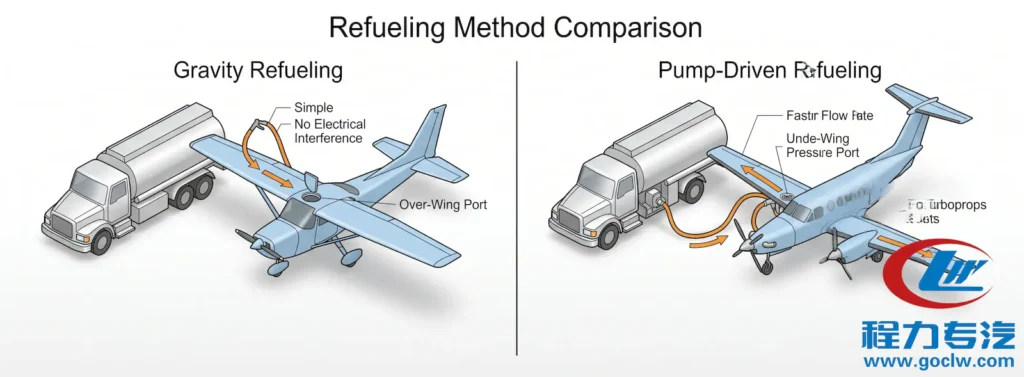
- Gravity refueling (standard on this 5,000L unit): Fuel flows by gravity through a hose reel to the aircraft tank. Simple, reliable, no electrical interference. Ideal for piston aircraft, light helicopters, and small turbine aircraft refueled from the over-wing port. The featured truck in this article is configured for gravity refueling.
- Pump-driven refueling: Adds a pressurized delivery system for faster fueling of larger aircraft. Recommended if your fleet includes turboprops or small jets with under-wing pressure-refueling ports.
- Combined gravity + pump: Best of both worlds — supports the full range of general aviation aircraft. Optional upgrade.
Additional Customization
- Hose length: Standard 15 m, extendable to 20 m or 25 m for larger apron operations.
- Nozzle type: Over-wing gravity nozzle (standard), under-wing pressure nozzle (upgrade), or both.
- Cold-climate package: Insulated tank wrap, heated piping, low-temperature seal materials — for operations below -20 °C.
- Hot-climate package: Reflective heat-insulation coating, upgraded ventilation, sun-shield over operator platform.
Why Choose CLW Group as Your Small Aircraft Refueling Truck Supplier
Sourcing aviation ground support equipment internationally carries real risk. The supplier must understand not only vehicle engineering but also aviation fuel handling, export logistics, and after-sales support across geographies.
Manufacturing Scale & Export Experience
Chengli Special Automobile Co., Ltd. (CLW Group) operates from Suizhou — designated by China’s Ministry of Industry and Information Technology as the country’s “Capital of Special Vehicles.” Our scale:
- 4,165+ acres of manufacturing facilities
- 38 specialized workshops including dedicated aviation tank fabrication
- 8,000+ skilled employees
- Annual production capacity of 100,000 vehicles
- 800+ vehicle models across 11 industry series
- Exported to 112+ countries worldwide
- 20+ years of specialized vehicle manufacturing experience
We manufacture aviation refuelers from 3,000L compact units up to 45,000L semi-trailer configurations, and ship directly from our Suizhou production base with zero intermediaries.
International Certifications & Quality Assurance
Every aviation refueling truck leaving our factory complies with:
- ISO quality management system certification
- ASME standards for pressure vessel components (where applicable)
- ADR compliance for hazardous materials road transport
- EU certification for European market entry
- CCC (China Compulsory Certification)
- 100% pre-delivery tested — hydraulic testing, leak detection, flow calibration, electrical safety verification
Tank fabrication follows automated vertical welding processes with full X-ray inspection on critical joints. We issue tank-inspection and flaw-detection reports with every delivered unit.
Recent Aviation & Fuel-Tank Delivery Cases
CLW has supplied aviation and fuel-tank vehicles to operators across Southeast Asia, South Asia, Africa, and Latin America. Recent notable deliveries include:
- Southeast Asian airport project (2026): Delivery of a 45 m³ pressure-and-gravity aircraft refueling semi-trailer, EU-certified, designed for narrow-body commercial aircraft. The project required full customization including double-mode refueling (pressure for under-wing ports, gravity for over-wing ports).
- Tanzania petrochemical fleet (2026): 42 m³ fuel tank semi-trailer with 6-compartment customization, supplied to a major regional petrochemical operator. (Note: this is a ground fuel-distribution vehicle, not aviation specification.)
- South Asian Ministry of Health (2026): Government-tier fleet order — 60 customized intelligent ambulances delivered in just 30 days. This case demonstrates our capacity to handle government tender volumes under tight deadlines.
These deliveries reflect the same engineering and quality-control processes applied to our 5,000L small aircraft refueling trucks.
Frequently Asked Questions About Small Aircraft Refueling Trucks
Q1: What’s the lead time for a customized 5,000L aviation refueler?
Standard configuration lead time is 30–45 days from confirmed deposit to ex-works delivery. Custom configurations involving RHD conversion, stainless steel tank upgrade, cold-climate or hot-climate packages, or non-standard chassis brands may extend lead time to 50–60 days. Rush-order accommodations are available for fleet orders — our recent 60-unit ambulance delivery to a South Asian Ministry of Health was completed in 30 days.
Q2: Can one truck handle both Avgas 100LL and Jet A-1?
No — and this is by design, not limitation. At the 5,000L capacity class, our aviation refuelers are built as single-compartment, single-fuel tanks. Mixing Avgas and Jet A-1 in the same tank or piping is a serious safety violation, and splitting a 5,000L tank into compartments would reduce each one to an operationally inefficient size while increasing contamination risk.
For operators serving both fuel types, the industry-standard solution is to specify two dedicated trucks — one for Avgas 100LL (red color-coding), one for Jet A-1 (black color-coding) — each operating independently. This is safer, simpler, and matches the global ground-handling standard used at FBOs worldwide.
Q3: What driving license is required for a 7,360 kg refueler?
In most countries, a vehicle with gross weight under 7,500 kg falls within the standard light-truck license category (B-class or equivalent). However, hazardous-materials endorsement (HAZMAT, ADR Class 3, or equivalent) is mandatory for any operator dispensing aviation fuel. Confirm local fuel-handling certification requirements with your civil aviation authority before deployment.
Q4: Do you provide RHD versions for export markets?
Yes. RHD versions are factory-built (not aftermarket conversions). We’ve supplied RHD aviation refuelers to operators in Pakistan, Tanzania, Kenya, Indonesia, Thailand, and other Commonwealth-tradition markets. Specify RHD at the inquiry stage to ensure correct chassis allocation.
Q5: How is the truck shipped internationally?
We ship via three main methods depending on destination and quantity:
- Roll-on/Roll-off (Ro-Ro) vessel: Most cost-effective for 1–3 units to major ports.
- 40-foot flat-rack container: Required for inland destinations where containerized delivery is mandatory.
- Bulk vessel: For fleet orders of 10+ units.
All vehicles are waxed and protected against sea-water corrosion before shipping. CIF, FOB, and DDP terms are all available — we handle export documentation, certificate of origin, and pre-shipment inspection.
Get Your Custom Quote for a 5,000L Aviation Refueling Truck
The right small aircraft refueling truck depends entirely on your operational profile — fuel type, fleet composition, terrain, climate, regulatory environment, and growth trajectory. There is no one-size-fits-all configuration.
CLW’s export team works directly with airport operators, fuel distributors, government agencies, and engineering contractors to specify the exact refueler configuration that fits your operation. We handle:
- Custom technical specification matching your aircraft fleet
- RHD/LHD configuration and emission-standard compliance for your market
- Chassis brand selection based on local parts and service network
- Export documentation, port logistics, and customs clearance
- Pre-shipment inspection and quality reports
Looking to import a small aircraft refueling truck from China? Get a custom quote within 24 hours. Contact Alvin at +86 18371886000 (WhatsApp) or [email protected]. Or browse our complete aviation refueling truck catalog at www.goclw.com to explore 5,000L–45,000L configurations.
CLW has delivered specialized aviation and fuel-tank vehicles to clients in 112+ countries. Let our 20 years of expertise serve your project.