
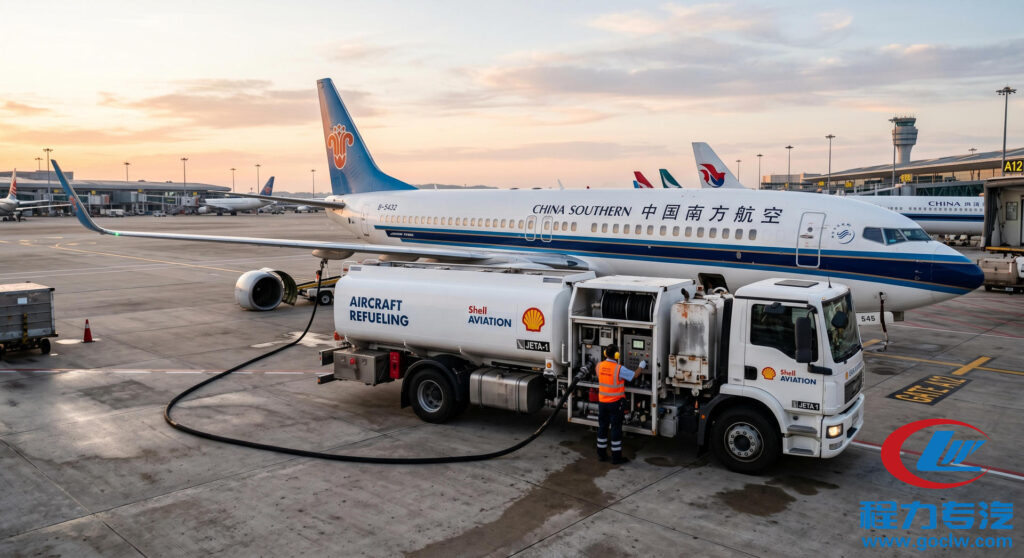
Choosing the wrong aircraft refueling truck does not just waste money — it grounds aircraft, fails safety audits, and exposes airports to multi-million-dollar contamination claims. Yet most buyer guides on the market read like product brochures, listing tank sizes without explaining what actually drives a sound purchasing decision.
This guide is different. Built from 20+ years of manufacturing experience at CLW Group and validated across 112+ export markets, it walks you through every decision point: how the truck works, how to match capacity to your aircraft fleet, which certifications matter for your region, how to compare chassis options, and how to read pricing without falling into the “cheap-and-broken” trap.
Whether you operate a regional airport, run a fixed-base operator (FBO) business, or procure for a national civil aviation authority, this guide gives you the framework to specify, compare, and source the right aircraft refueling truck.
What Is an Aircraft Refueling Truck? (And Why Choosing the Right One Matters)
An aircraft refueling truck — also called an aviation refueler, jet fuel truck, or aircraft fuel servicing tank truck — is a specialized vehicle designed to transport, filter, meter, and dispense aviation fuel directly into aircraft on the apron or at remote stands.
Unlike standard road tankers that move diesel or gasoline, aircraft refueling trucks must handle Jet A-1 keroseneor aviation gasoline (AvGas) under three uncompromising conditions:
- Fuel purity — even microscopic water or particulate contamination can cause engine flameout.
- Pressure stability — pressure spikes during underwing refueling can damage aircraft fuel systems.
- Operational safety — every component must resist static discharge, vapor ignition, and accidental over-pressurization.
Getting the specification wrong has cascading consequences. An undersized tank means more refueling cycles and slower aircraft turnaround. The wrong filtration grade can introduce water into a turbine engine. Missing certifications can disqualify the truck from operating airside at international airports. And a chassis unsuited to your local climate or road conditions will fail prematurely, costing far more than the original savings.
This guide is structured around the six decisions every buyer must make: capacity, components, certifications, chassis, pricing, and supplier.
How an Aircraft Refueling Truck Works: 6 Critical Systems Explained
A modern aircraft refueling truck is not a single machine — it is six integrated systems working in synchronization. Understanding each system helps you specify the truck correctly and ask suppliers the right questions.
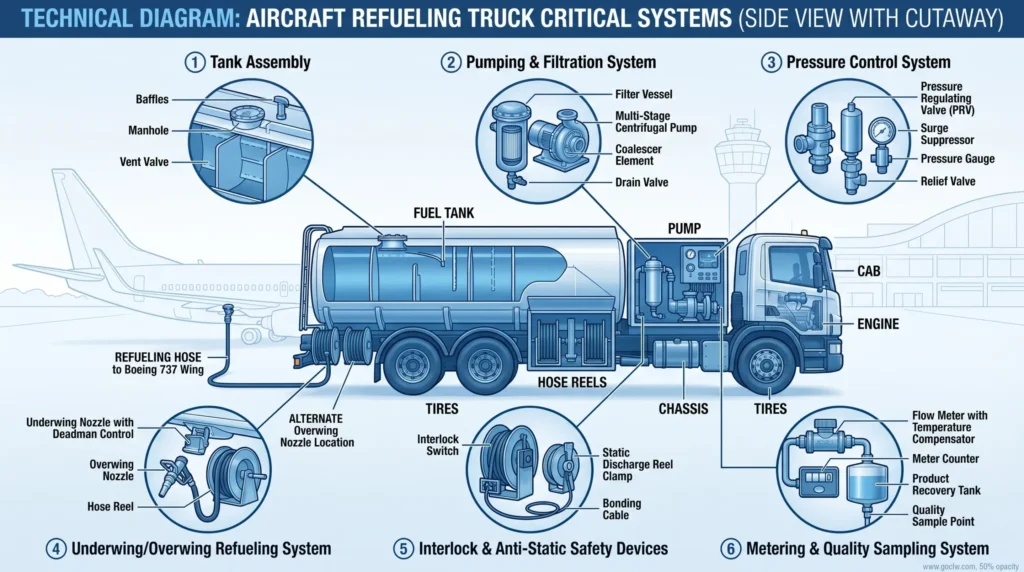
Tank Assembly: Aluminum Alloy vs Stainless Steel
The tank is the heart of the truck. For aviation fuel, two materials dominate the market:
- Aluminum alloy (5083 marine-grade) — lightweight, corrosion-resistant, and the international standard for civil aviation refuelers. Lower deadweight means more payload within the same gross vehicle weight rating.
- Stainless steel (304 / 316L) — heavier and more expensive, but offers superior durability in harsh chemical environments. Common where the same truck handles multiple fuel grades.
For most commercial airport operations, aluminum alloy 5083 is the recommended choice. CLW supplies both, with full material traceability documentation for compliance audits.
Pumping & Filtration System
The pumping system delivers fuel from the tank to the aircraft at controlled pressure. A typical configuration includes:
- A stainless-steel centrifugal or positive displacement pump (rated 600–2,000 liters per minute).
- A filter-water separator complying with API/IP 1581 standards, removing particulates down to 5 microns and free water.
- Differential pressure gauges monitoring filter saturation in real time.
Filtration is non-negotiable. A single filter failure can ground an entire fleet — which is why every CLW refueler ships with audit-ready filter certification documents.
Pressure Control & Voltage Stabilizer
Aviation fuel must enter aircraft tanks at strictly regulated pressure — typically capped at 50 PSI (345 kPa) at the nozzle. The truck achieves this through:
- A primary pressure regulator on the discharge line.
- A secondary surge suppressor protecting against pressure spikes.
- A pressure relief valve as a final safety backstop.
- Real-time pressure gauges visible to the operator.
This three-layer protection is what separates an aircraft refueler from an ordinary fuel tanker.
Underwing & Overwing Refueling Modes
Different aircraft require different refueling methods:
- Underwing (pressure) refueling — used for commercial jets. A single-point connection delivers fuel rapidly under pressure through a Single Point Refueling (SPR) nozzle.
- Overwing (gravity) refueling — used for small aircraft, helicopters, and general aviation. Fuel flows by gravity through a hose-reel and dispensing nozzle from the top of the wing.
A well-designed refueler supports both modes, giving operators flexibility across mixed fleets.
Interlock & Anti-Static Safety Devices
Aviation refueling environments demand multiple layers of fail-safe protection:
- Interlock control system — the truck cannot move while refueling is active, and cannot refuel while the engine is in drive.
- Anti-static grounding — bonding cables connect truck to aircraft, preventing electrostatic ignition.
- Emergency shut-off — operator-accessible buttons cut all flow within seconds.
- Explosion-proof electrical components — every switch, light, and motor in the fuel zone is rated for hazardous atmospheres.
Metering & Quality Sampling System
Every liter dispensed must be measured for billing and traceability:
- High-accuracy positive displacement flow meters (accuracy class 0.5).
- Pre-set delivery batching with automatic shut-off.
- Sampling ports before and after filtration for laboratory verification.
- Temperature-compensated volume calculation.
These systems together transform a tank truck into a certified airport-grade asset.
Aircraft Refueling Truck Capacity Selection: A Capacity-to-Aircraft Matrix
Tank capacity is the single most important decision in your purchase. Too small, and you double your refueling cycles. Too large, and you waste capital and reduce maneuverability on the apron.
The right capacity depends on your aircraft mix, daily fuel throughput, and apron layout. Use the matrix below as your starting reference:
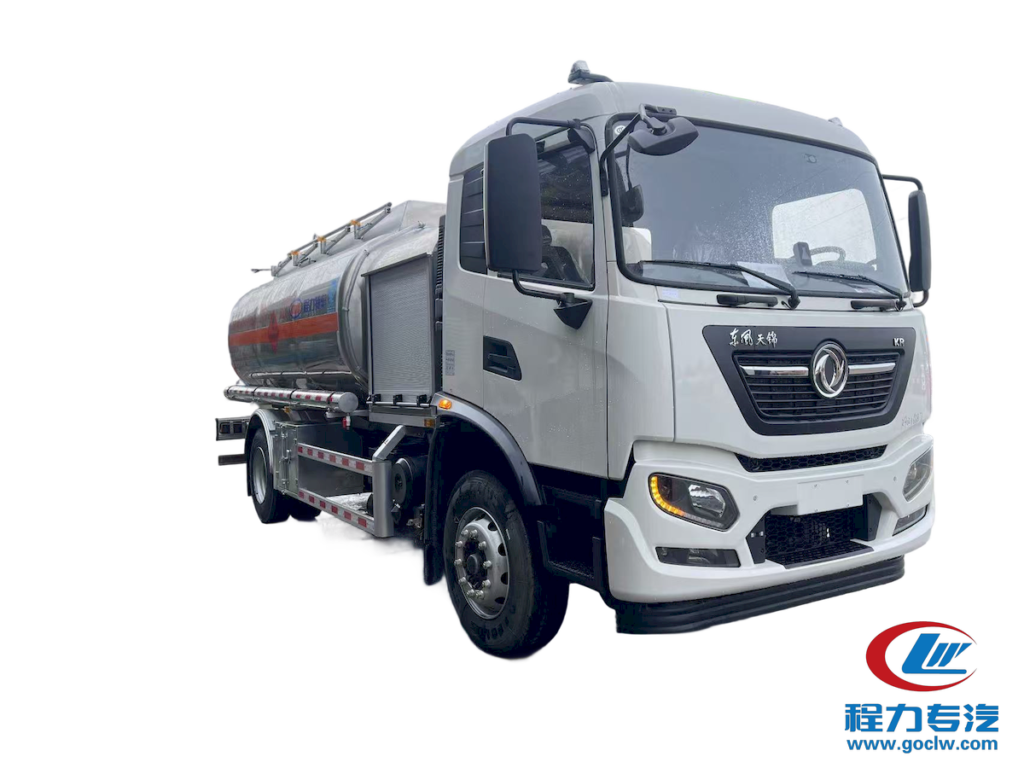
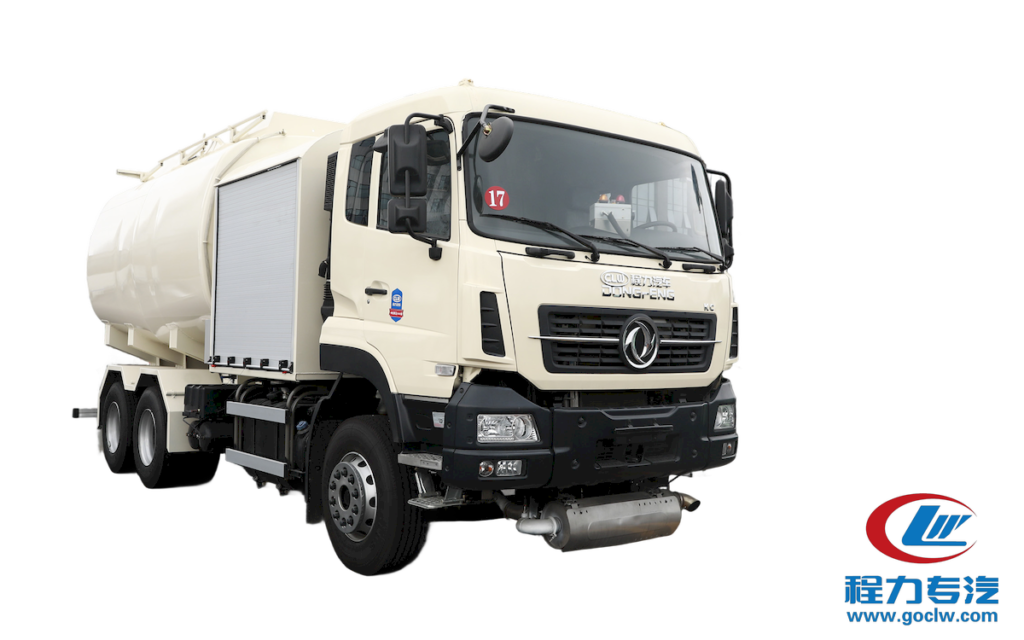
| Tank Capacity | Best Suited For | Typical Chassis | Refueling Mode |
|---|---|---|---|
| 5,000 – 10,000 L | Helicopters, light aircraft, general aviation | 4×2 light or medium chassis | Mainly overwing (gravity) |
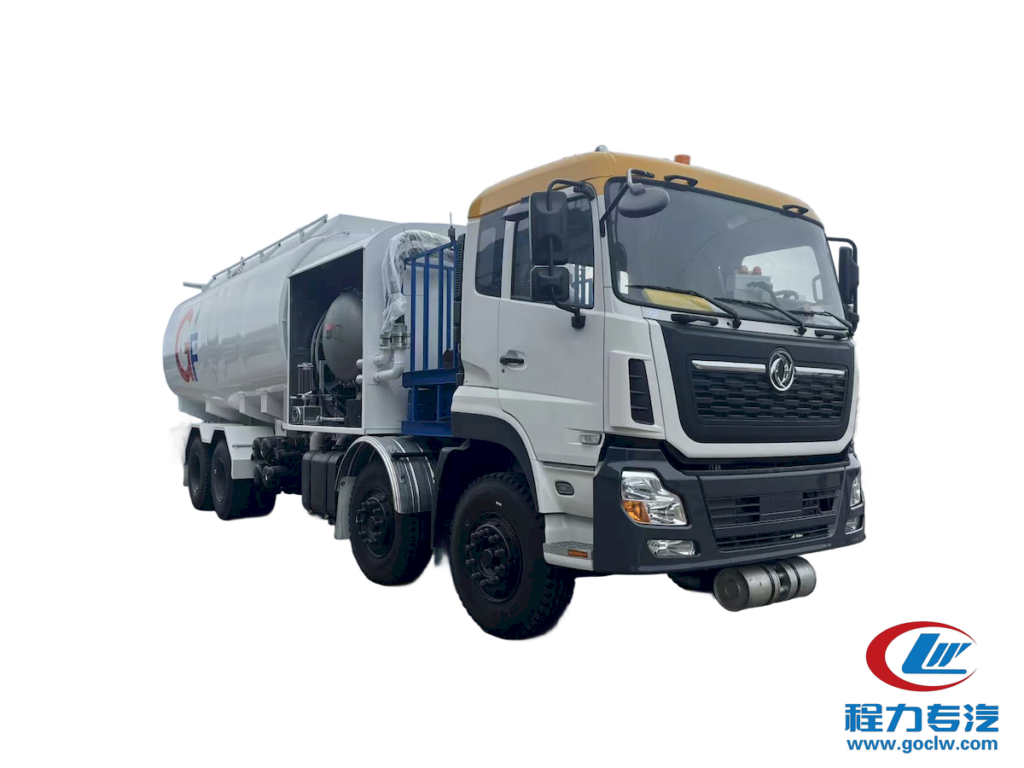
| 13,000 – 20,000 L | Regional jets (ATR 72, Embraer E-Jets, Bombardier Q400) | 4×2 or 6×4 medium chassis | Both modes |
| 25,000 – 30,000 L | Narrow-body jets (Boeing 737, Airbus A320 family) | 6×4 or 8×4 heavy chassis | Mainly underwing (pressure) |
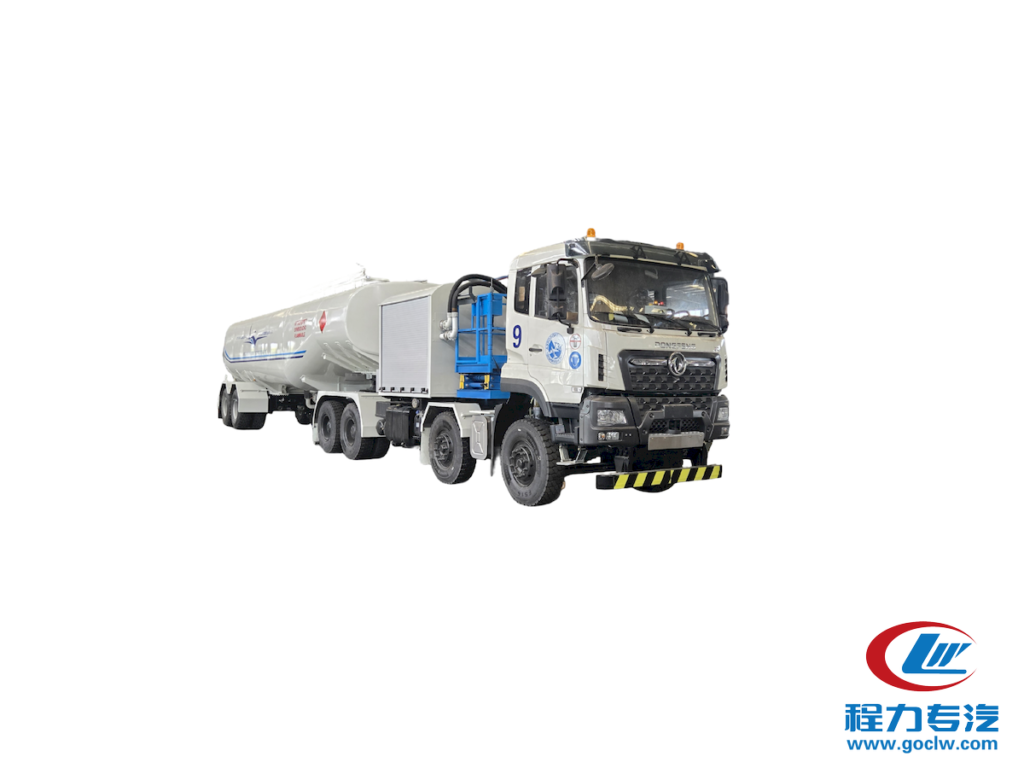
| 38,000 – 45,000 L | Wide-body jets (Boeing 777, Airbus A330/A350) | 6×4 tractor + tanker semi-trailer | Mainly underwing, high-flow pressure |
5,000 – 10,000 L: For Helicopters and General Aviation
These compact refuelers serve helipads, flight schools, agricultural aviation, and small regional airfields. Mounted on light Isuzu, JAC, or Dongfeng chassis, they prioritize maneuverability over volume. Most operate exclusively in gravity mode with a single hose reel.
13,000 – 20,000 L: For Regional Jets
The most versatile category, suitable for secondary airports handling regional traffic. A 6×4 chassis provides the stability needed for full-load operation, while dual-mode capability allows the same truck to service both regional jets and visiting general aviation.
25,000 – 30,000 L: For Narrow-Body Aircraft
This is the workhorse category for major commercial airports. Configured on 8×4 heavy chassis with high-flow underwing systems delivering 1,200 liters per minute, these trucks can fully refuel a Boeing 737 in a single connection cycle.
38,000 – 45,000 L Semi-Trailer: For Wide-Body Aircraft
Wide-body refueling demands semi-trailer configurations. The tractor-trailer combination delivers maximum payload while distributing weight across multiple axles to comply with apron load limits. High-flow pressure systems (typically 2,500+ LPM) match the rapid fuel uptake of aircraft like the Boeing 777 and Airbus A330.
International Certifications Explained: ISO, ASME, ADR, EU & MIIT
Certifications are not paperwork — they are the gatekeepers that decide whether your truck can legally operate at your destination airport. Buying an uncertified truck is the single most common procurement mistake we see in emerging markets.
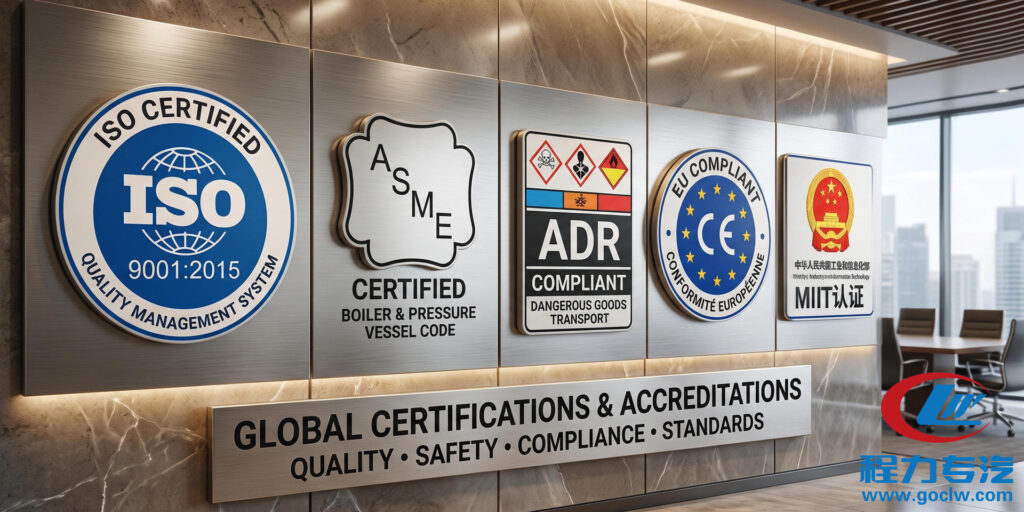
Here is what each major certification means in practice:
ISO 9001: The Global Quality Baseline
ISO 9001 certifies that the manufacturer operates a documented quality management system. It is the minimum credential any serious buyer should require. Without ISO 9001, you have no third-party verification that the factory follows consistent production processes.
CLW Group has held ISO 9001 certification since the early 2000s, with full documentation available for buyer audits.
ASME: Pressure Vessel Compliance for Tank Bodies
The American Society of Mechanical Engineers (ASME) Boiler and Pressure Vessel Code is the global benchmark for pressure-bearing tank construction. While not legally required in every market, ASME certification signals that the tank can withstand pressure cycles, vacuum loading, and structural fatigue under aviation operating conditions.
ASME-certified tanks are particularly valued in Middle East, North African, and Latin American markets where international procurement standards apply.
ADR / EU Certification: For European-Standard Markets
ADR (the European Agreement concerning the International Carriage of Dangerous Goods by Road) governs how dangerous goods — including aviation fuel — are transported. EU certification covers broader vehicle compliance for the European Union and EU-aligned markets.
For buyers in countries that follow European technical standards, ADR/EU compliance is often non-negotiable.
MIIT (Chinese Ministry of Industry and Information Technology)
China’s MIIT certification is a national-level designation issued only to manufacturers meeting strict production capacity, technical capability, and quality control thresholds. For international buyers, MIIT certification serves as proof that the manufacturer is recognized at the highest level by the Chinese government — distinguishing established factories from informal assemblers.
Which Certifications Matter for Your Market?
| Target Market | Priority Certifications | Why |
|---|---|---|
| Southeast Asia (Vietnam, Indonesia, Philippines, Thailand) | ISO 9001 + MIIT | Quality assurance and government-recognized supplier status |
| South Asia (India, Bangladesh, Sri Lanka, Nepal) | ISO 9001 + ASME | Pressure vessel compliance for government tenders |
| Middle East & North Africa | ASME + ISO 9001 | Aligns with petrochemical industry standards |
| Sub-Saharan Africa | ISO 9001 + MIIT | Practical quality verification for government procurement |
| Latin America | ASME + ISO 9001 | Pressure vessel codes match local regulations |
| European Union | ADR + EU Certification | Legally required for road transport |
For Southeast Asian and South Asian buyers — the primary readers of this guide — ISO 9001 combined with ASME pressure vessel certification covers virtually all procurement scenarios, including airport authority tenders and private FBO purchases.
Chassis Options Compared: Sinotruk, Dongfeng, Shacman, FAW & Isuzu
The chassis is the foundation of every aircraft refueling truck. Five chassis brands dominate the export market, each with distinct strengths.
Drive Configurations: 4×2, 6×4, and 8×4
| Configuration | Suitable Tank Capacity | Best Use Case |
|---|---|---|
| 4×2 | 5,000 – 13,000 L | Light to medium refuelers, paved aprons, light traffic |
| 6×4 | 15,000 – 25,000 L | Most commercial refuelers, balanced payload and maneuverability |
| 8×4 | 25,000 – 30,000 L | Heavy-duty refuelers for major airports, maximum stability |
| 6×4 tractor + semi-trailer | 38,000 – 50,000 L | Wide-body operations, high-volume hub airports |
Engine Power and Emission Standards
Most export markets accept Euro 3 and Euro 5 emission standards, with Euro 6 reserved for European Union and select Asian markets. Engine power scales with chassis size:
- 4×2 light chassis: 160 – 220 horsepower
- 6×4 medium chassis: 280 – 380 horsepower
- 8×4 heavy chassis: 380 – 460 horsepower
Left-Hand Drive vs Right-Hand Drive
Right-hand drive (RHD) configurations are essential for markets including India, Pakistan, Bangladesh, Sri Lanka, Indonesia, Thailand, Malaysia, and many African countries. CLW supplies both LHD and RHD configurations across all chassis brands, with no surcharge for RHD on standard models.
Chassis Brand Quick Comparison
| Brand | Reputation | Best For |
|---|---|---|
| Sinotruk (HOWO) | Heavy-duty workhorse, widely available spare parts | Africa, Middle East, Latin America |
| Dongfeng | Balanced cost-performance, strong service network | Southeast Asia, South Asia, Africa |
| Shacman | Robust heavy-duty performance | Central Asia, Middle East |
| FAW Jiefang | Reliable fleet operator’s choice | Mixed-market deployment |
| Isuzu | Premium light-to-medium category, exceptional reliability | Southeast Asia, helicopter and GA refuelers |
For Southeast Asian and South Asian buyers, Dongfeng and Isuzu chassis are the most popular choices — Dongfeng for its competitive pricing and service network, Isuzu for premium reliability in lighter capacity applications.
Aircraft Refueling Truck Price Guide: What Drives the Cost?
Pricing for aircraft refueling trucks is rarely transparent — and that opacity hides both legitimate cost differences and sometimes inflated margins. Here is what actually drives the price.
The 7 Factors That Move the Price
- Tank capacity — the single largest cost driver. Doubling capacity does not double price, but the relationship is nearly linear.
- Tank material — stainless steel costs slightly more than aluminum alloy, but durability gains may justify it for multi-fuel applications.
- Chassis brand and configuration — Isuzu commands a premium over Sinotruk; 8×4 costs more than 6×4.
- Pumping and filtration grade — high-flow imported pumps and API-certified filters significantly raise the bill of materials.
- Certifications required — ASME-certified tanks add documentation, inspection, and material costs.
- Customization level — single-compartment vs multi-compartment, dual-mode refueling, automatic shut-off integration, and onboard diagnostic systems each add cost.
- Emission standard — Euro 5 and Euro 6 chassis cost more than Euro 3 equivalents.
Why China-Manufactured Trucks Cost 30 – 50% Less
The price gap between Chinese and Western-manufactured aircraft refueling trucks is not a matter of cutting corners — it reflects fundamental differences in cost structure:
- Vertical integration — manufacturers like CLW produce tanks, fabricate piping, and assemble final units in-house, eliminating multiple supplier markups.
- Manufacturing scale — China produces more special-purpose vehicles annually than any other country, allowing fixed-cost amortization across high volumes.
- Local component supply chain — pumps, valves, and electrical components are sourced from a mature domestic supplier base, with imported components used only where international standards require.
- Labor and overhead efficiency — skilled labor costs in China remain competitive while the workforce is highly experienced in special-vehicle production.
The result: a Chinese-manufactured aircraft refueling truck with equivalent specifications, full international certifications, and matching component grades typically costs 30 – 50% less than its European or American counterpart — with no compromise on certified quality.
The savings free up capital for more units, better spare parts inventory, or longer warranty coverage. For airport authorities operating multiple refuelers, the total fleet cost impact is substantial.
Buying from China: 5 Reasons CLW Group Is the Trusted Choice
For buyers evaluating Chinese suppliers, the challenge is separating established manufacturers from informal trading companies that subcontract production. Here is what sets CLW Group apart:
1. National-Level Recognition
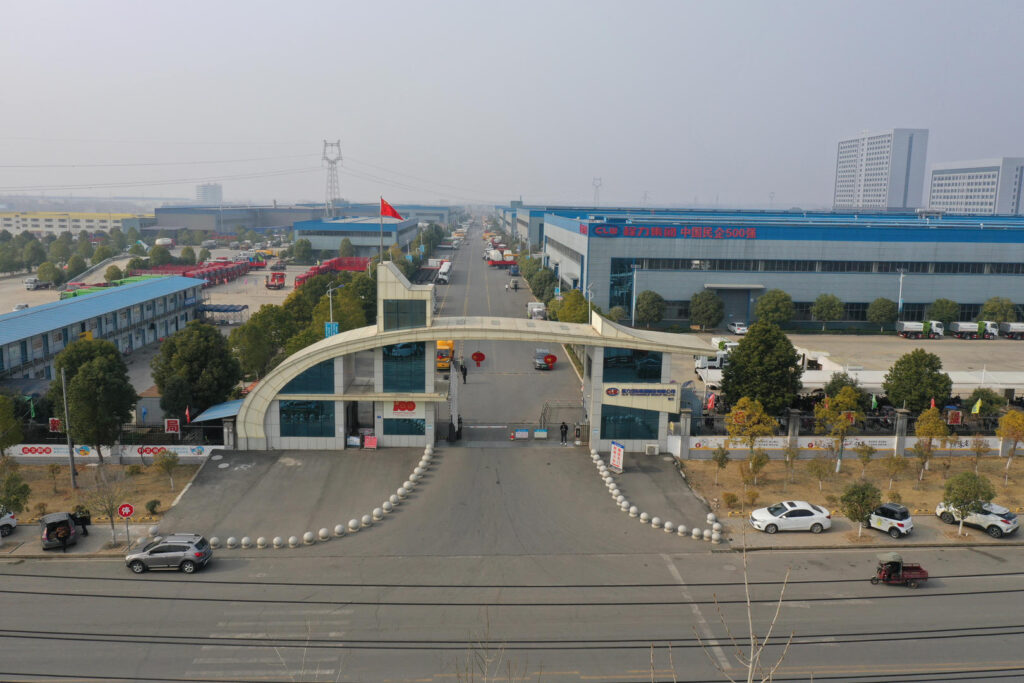
Headquartered in Suizhou — known as China’s “Capital of Special Vehicles” — CLW is appointed by China’s Ministry of Industry and Information Technology as a national-level special vehicle manufacturer. This is not a marketing claim. It is a government designation that requires meeting strict production capacity, technical capability, and quality system thresholds.
2. Manufacturing Scale That Matters
- 4,165+ acres of integrated manufacturing base.
- 8,000+ skilled employees across 38 specialized workshops.
- Annual production capacity of 100,000 special vehicles.
- 800+ customizable models across 11 product series.
This scale matters because it means your project does not depend on a single workshop, a single supplier, or a single technical lead. It is backed by industrial infrastructure.
3. Proven Global Track Record
CLW vehicles operate in 112+ countries worldwide, with over 10,000 clients ranging from government ministries to private operators. Every aircraft refueling truck undergoes 100% pre-delivery testing, with documented inspection records released to the buyer.
4. Full Certification Coverage
CLW maintains active ISO 9001, ASME, ADR, EU, and CCC certifications, with documentation prepared for international audits. For buyers participating in government tenders, CLW provides certification packages tailored to local requirements.
5. End-to-End Export Capability
From initial specification consultation, through manufacturing, factory acceptance testing, port logistics, and after-sales technical support — CLW handles the complete export workflow in-house. Buyers deal with one accountable team, not a chain of intermediaries.
Browse our complete aviation refueler models catalog to start your specification.
Frequently Asked Questions
What is the difference between Jet A and Jet A-1 fuel?
Both are kerosene-based aviation turbine fuels with nearly identical performance specifications. The key difference is the freezing point: Jet A freezes at –40°C, while Jet A-1 freezes at –47°C. Jet A-1 is the international standard outside the United States, used for commercial aviation worldwide. Aircraft refueling trucks intended for international markets are typically configured for Jet A-1.For other aviation-related fuel transport needs, see our LPG tank truck range as well.
How long does it take to manufacture and ship an aircraft refueling truck?
Standard models require 25 – 35 working days from order confirmation to factory completion. Customized configurations — particularly those involving specific chassis sourcing, multi-compartment tanks, or custom certification packages — typically require 45 – 60 days. Ocean shipping adds 25 – 45 days depending on destination port. Total lead time from purchase order to delivery typically ranges 60 – 105 days.
Can the truck be customized for left-hand drive (LHD) or right-hand drive (RHD)?
Yes. CLW manufactures both LHD and RHD configurations across all chassis brands. RHD is supplied at no additional cost on standard models, with delivery times comparable to LHD versions. Always confirm RHD requirements at order placement, as some chassis variants require longer procurement lead times.
What is the lifespan of an aluminum-alloy fuel tank?
A properly maintained 5083 marine-grade aluminum alloy tank has a service life of 20 – 25 years under normal aviation operating conditions. Lifespan depends on factors including fuel quality consistency, regular cleaning protocols, environmental exposure, and adherence to recommended pressure operating limits. Stainless steel tanks can exceed 30 years but at higher initial cost.
How is after-sales support handled for overseas buyers?
CLW provides multilingual technical support remotely, ships spare parts globally on request, and maintains service partnerships in multiple regions for on-site assistance. Standard warranty covers one year on the complete vehicle and longer periods on specific systems. Extended warranty packages and dedicated technician dispatch can be arranged for major projects.
Ready to Source Your Aircraft Refueling Truck?
Specifying the right aircraft refueling truck requires matching capacity to your fleet, aligning certifications with your market, choosing a chassis suited to your conditions, and partnering with a manufacturer who will be there long after delivery.
CLW Group has been doing exactly this for 20+ years across 112+ countries. Whether you are sourcing a single helicopter refueler or fielding a complete airport refueling fleet, we will help you specify, configure, and deliver the right solution.
Get a custom quote within 24 hours:
📧 Email: [email protected]
📱 WhatsApp: +86 18371886000
🌐 Website: www.goclw.com
Send us your aircraft type, required tank capacity, target market, and any specific certification requirements — we will respond with a complete configuration proposal and FOB pricing within one business day.