
Choosing the wrong aerial work platform truck is one of the most expensive mistakes a fleet buyer can make. A 28-meter telescopic boom may look impressive on a spec sheet, but if your real job is trimming roadside trees on narrow city streets, that same truck will sit idle in the depot — too heavy, too tall, too costly to operate.
This guide is written for overseas buyers in Southeast Asia, South Asia, Africa, the Middle East, Latin America, and Central Asia who are evaluating an aerial work platform truck for utility maintenance, municipal services, telecom installation, tree care, or industrial access. Instead of repeating generic product descriptions, we focus on the selection logic that actually decides whether your investment pays back in 18 months or becomes a depreciating headache.
By the end of this guide, you will be able to answer four practical questions with confidence:
- Which boom type fits your real working scenarios?
- What working height range matches your tasks — without overpaying for unused reach?
- Which truck chassis is correct for your road conditions and local regulations?
- How do you source from China without being burned by low-quality suppliers?
CLW has been manufacturing special-purpose vehicles in Suizhou — China’s officially recognized “Capital of Special Vehicles” — for over 20 years, with deliveries to clients in 112+ countries. The recommendations below come from that real-world export experience, not marketing brochures.
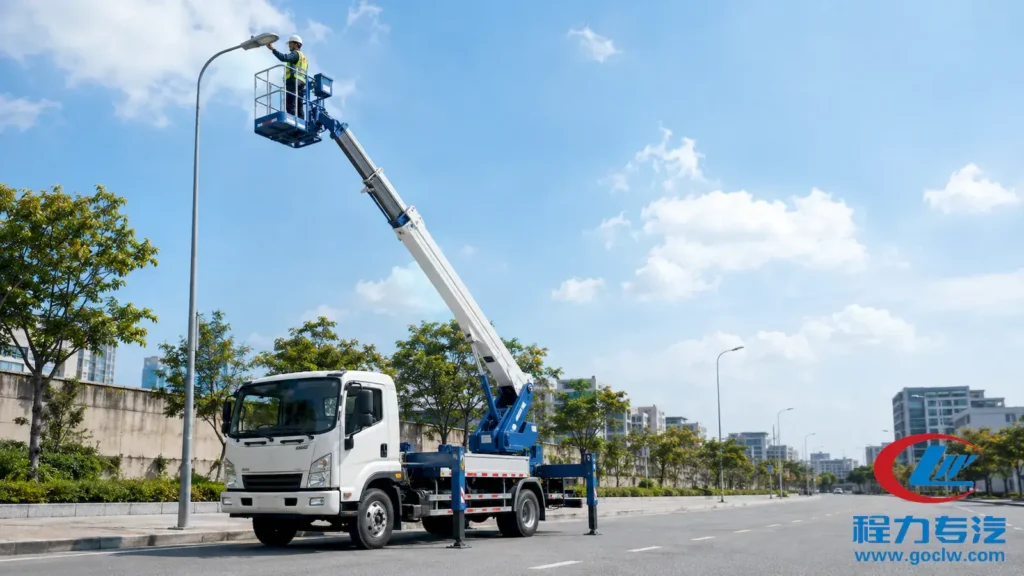
What Is an Aerial Work Platform Truck? (And Why Mounting Matters)
An aerial work platform truck — also commonly called a bucket truck, boom lift truck, or truck-mounted aerial work platform — is a road-legal commercial vehicle with a hydraulically operated elevating platform mounted on its chassis. Workers stand inside the basket (or “bucket”) to safely perform tasks at height, such as repairing streetlights, installing telecom cables, trimming trees, or maintaining building façades.
The key word is mounted. The lifting mechanism is permanently integrated into a truck chassis, which means the entire unit can drive on public roads from one job site to the next without a separate trailer or transport vehicle. This is what separates an aerial work platform truck from a self-propelled scissor lift or a towable boom lift.
Truck-Mounted vs. Self-Propelled: When to Choose Which
For overseas buyers, this is usually the first decision point. Each format solves a different operational problem.
| Feature | Truck-Mounted Aerial Platform | Self-Propelled AWP (Scissor / Spider) |
|---|---|---|
| Road mobility | Road-legal, drives between job sites at highway speed | Requires a transport truck or trailer |
| Best for | Daily route-based work across a wide service area | Single-site projects, indoor work, confined spaces |
| Working height | Typically 14m – 45m+ | Typically 6m – 20m (scissor); up to 30m (spider) |
| Setup time | Park → deploy outriggers → operate (under 5 minutes) | Lower setup, but transport adds hours |
| Typical buyers | Utility companies, municipalities, telecom operators | Construction sites, warehouses, indoor maintenance |
If your crews need to cover multiple work locations per day — for example, a municipal street-lighting team servicing different districts — a truck-mounted aerial work platform almost always wins on total cost of operation.
Core Components Every Buyer Should Recognize
Before comparing models, learn these five components. They are where most of your money goes, and where quality differences become obvious during the first year of use:
- Boom assembly — the lifting arm itself, which can be telescopic, articulated, or a hybrid of both. Boom material grade and welding quality directly affect lifespan.
- Work basket (or “bucket”) — the enclosed platform where the operator stands. Capacity is usually rated for 200 kg to 400 kg, including workers, tools, and materials.
- Outriggers (stabilizers) — extendable legs that level the truck and absorb the load during operation. Without correctly designed outriggers, the entire truck can become unstable.
- PTO and hydraulic system — the Power Take-Off (PTO) draws power from the truck’s engine to drive the hydraulic pump that raises and rotates the boom. A well-engineered hydraulic system is the difference between smooth, controlled lifting and dangerous jerky movement.
- Dual control system — modern aerial work platform trucks include controls in both the cab and the basket, allowing the operator in the air to manage their own movements safely.
If a supplier cannot clearly explain how each of these is built and certified, that is your first warning sign. We will return to supplier red flags in a later section.
The 4 Main Types of Aerial Work Platform Trucks Explained
This is the section most buyers skip — and the section that determines whether your purchase actually solves your operational problem. There are four main truck-mounted aerial platform types, and each is engineered for a different geometric challenge.
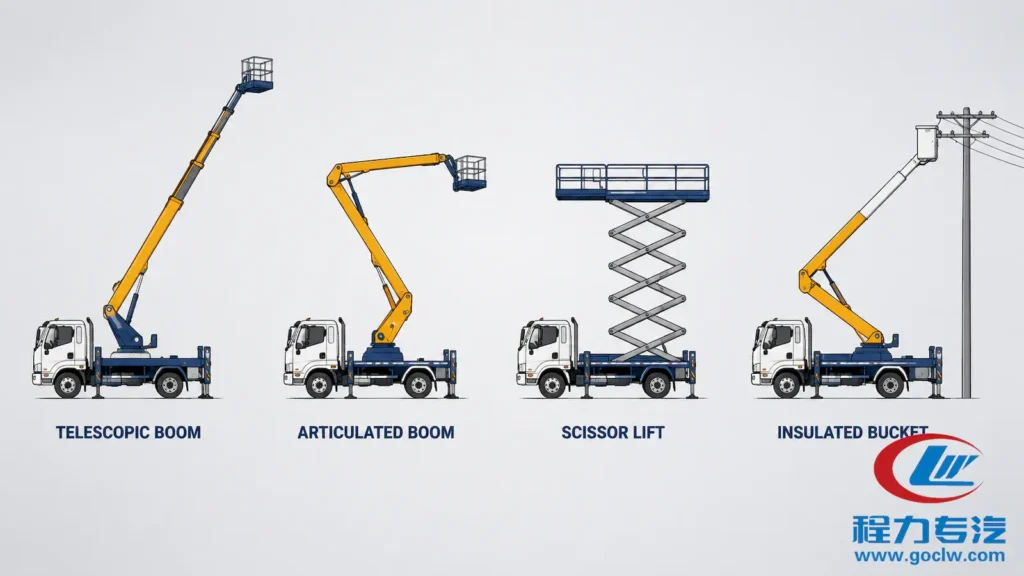
Telescopic (Straight) Boom Truck — Maximum Reach, Minimum Maneuver
A telescopic boom truck uses a straight, multi-section arm that extends like a fishing rod. It delivers the longest horizontal and vertical reach of any truck-mounted format, which makes it the go-to choice for high-altitude work where the obstacle between you and the work point is distance, not geometry.
Best suited for:
- Power line inspection and repair on open transmission corridors
- High-rise façade cleaning and painting
- Industrial plant maintenance (refineries, chemical plants, large warehouses)
- Tall signage and billboard installation
Working height range: Typically 16m to 45m+, with custom configurations available beyond that.
Watch out for: Telescopic booms have limited ability to bend around obstacles. If your operators routinely need to reach over a wall, fence, or vehicle, a telescopic boom alone is the wrong tool.
Articulated (Knuckle) Boom Truck — Reaching Over Obstacles
The articulated boom — sometimes called a knuckle boom or cherry picker — has one or more hinged joints in the arm. This gives the operator the ability to lift the basket up, then bend it over a barrier and bring it down into a target area that a straight boom cannot access.
Best suited for:
- Tree trimming above traffic lanes or fenced gardens
- Bridge inspection (working over a railing into a structural area)
- Building maintenance where windows or balconies block straight access
- Aircraft de-icing and ground service work
Working height range: Typically 14m to 33m, depending on configuration.
Watch out for: Articulated booms trade absolute reach for flexibility. For pure maximum-height work with no obstacles, a telescopic boom of the same chassis class will usually reach further.
Scissor Lift Truck — Wide Platform for Vertical-Only Tasks
A truck-mounted scissor lift uses a folding criss-cross support system to raise a large platform vertically. The advantage is the size of the work surface: scissor decks can comfortably accommodate two to four workers plus tools and materials, which is ideal for jobs that require sustained team work at a single elevation point.
Best suited for:
- Warehouse ceiling installation and maintenance
- Indoor industrial work where ceiling-grade access is needed
- Multi-worker tasks where a small basket is too restrictive
- Material handling at moderate heights
Working height range: Typically 8m to 16m for truck-mounted versions.
Watch out for: Scissor lifts have no lateral reach. The platform only goes straight up. If you need to access anything that is not directly above the truck’s parking position, you will need to reposition the entire vehicle.
Insulated Bucket Truck — Built for Live Electrical Work
An insulated bucket truck is a specialized aerial work platform truck designed with dielectric (non-conducting) properties built into the boom, basket liner, and hydraulic system. This insulation allows trained linemen to safely work near, and in some configurations directly on, energized power lines.
Best suited for:
- Electric utility maintenance and emergency repair
- Distribution line work (medium and low voltage)
- Substation servicing
- Telecom and fiber optic deployment on shared power poles
Working height range: Typically 14m to 30m, with voltage ratings configurable to local utility standards.
Watch out for: Not every “bucket truck” is actually insulated. Real dielectric performance requires certified materials, regular testing, and clearly documented voltage ratings. Buying a non-insulated aerial platform and using it for live-line work is extremely dangerous — and unfortunately, it happens more often than it should when buyers don’t ask the right questions.
Quick Reference: Boom Type vs. Best Use Case
| Boom Type | Reach Profile | Best Use Case | Typical Buyer |
|---|---|---|---|
| Telescopic (Straight) | Maximum height & distance | Open-area high-reach work | Industrial plants, power utilities |
| Articulated (Knuckle) | Reaches over obstacles | Tree care, bridge & façade work | Municipalities, arborists |
| Scissor Lift | Wide vertical platform | Multi-worker indoor tasks | Warehouses, indoor facilities |
| Insulated Bucket | Dielectric protection | Live electrical line work | Utility companies, telecom |
CLW manufactures all four types across multiple chassis classes — explore our complete aerial work platform truck lineup or browse the full 800+ special vehicle catalog covering 11 product series. If you are not yet sure which boom type matches your work, the application section later in this guide will help you cross-reference your daily tasks against the right configuration.
How to Choose the Right Working Height (14m to 45m+)
After boom type, working height is the second-most-misjudged specification — usually in the direction of buying too much. Buyers tend to assume that more height equals more value, but in practice every additional meter of reach adds weight, fuel consumption, setup time, and purchase cost.
The correct approach is to identify your most common daily task, choose a height that comfortably covers it with a small safety margin, and then verify whether your occasional longer-reach tasks justify upgrading to the next class.
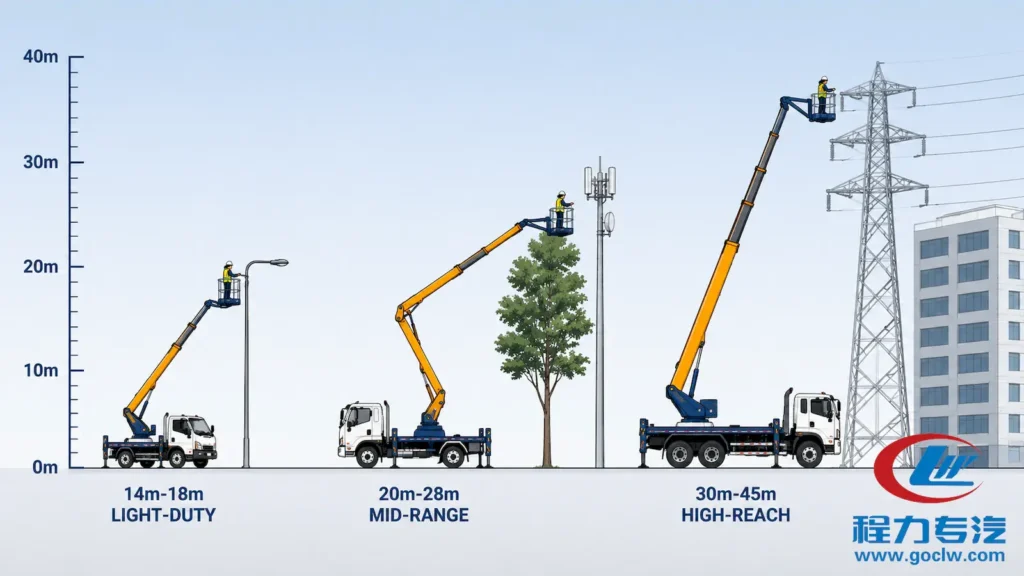
Light-Duty (14m–18m): Streetlight, Signage, Indoor Maintenance
This range covers the majority of routine urban maintenance work worldwide. Streetlights in most cities are between 8m and 12m tall, which means a 14m–18m aerial work platform truck has enough vertical reach with room to position the basket safely above the work point.
Typical tasks at this height range:
- Municipal streetlight installation, replacement, and bulb servicing
- Traffic signal repair
- Storefront signage and advertising banner installation
- Small-tree pruning in urban environments
- Indoor warehouse and factory roof maintenance
Recommended chassis class: Light-duty, such as Isuzu, JMC, or Foton 4×2 platforms. These are easier to maneuver in narrow streets and have lower operating costs.
Mid-Range (20m–28m): Tree Trimming, Telecom, Building Façade
The mid-range class is the most versatile category, which is why it accounts for a large share of municipal and commercial fleet purchases across Africa, Southeast Asia, and Latin America. At 20m–28m, you can handle nearly every routine outdoor maintenance task short of heavy industrial work.
Typical tasks at this height range:
- Mature tree trimming and roadside vegetation management
- Telecom cable installation on standard utility poles
- Mid-rise building façade maintenance and window cleaning
- Distribution-level electrical work (with insulation, if live)
- Commercial signage on highway structures
Recommended chassis class: Medium-duty, such as Dongfeng, JAC, or FAW 4×2 platforms. These offer the right balance of payload capacity, road agility, and fuel efficiency.
High-Reach (30m–45m+): Power Lines, High-Rise, Industrial Plants
When the work point is on a high-voltage transmission tower, a multi-story building, or an industrial structure, you need a high-reach aerial work platform truck. This class also requires careful attention to chassis stability — the higher the boom extends, the more critical the outrigger footprint and counterweight design become.
Typical tasks at this height range:
- High-voltage transmission line inspection and repair
- High-rise building exterior maintenance
- Industrial plant access (refineries, cement plants, large factories)
- Tall communication tower servicing
- Stadium and large-venue lighting maintenance
Recommended chassis class: Heavy-duty, such as Sinotruk HOWO or Shacman, often in 6×4 drive configuration for stability on uneven ground.
Working Height vs. Task Reference Table
| Working Height | Primary Applications | Recommended Chassis Class |
|---|---|---|
| 14m – 18m | Streetlights, signage, indoor maintenance | Light-duty (Isuzu, JMC, Foton) |
| 20m – 28m | Tree care, telecom, façade work | Medium-duty (Dongfeng, JAC, FAW) |
| 30m – 45m+ | Power lines, high-rise, industrial | Heavy-duty (Sinotruk, Shacman) |
A practical rule from our 20+ years of export experience: add roughly 2m of safety margin above your tallest routine work point, not above your rarest one. Trying to size a truck for the once-a-year exceptional job almost always results in an oversized vehicle that costs more to operate every single day.
Chassis Selection: Why It’s the Real Cost Driver
Many overseas buyers focus almost entirely on the boom — its height, its rotation angle, its basket capacity — and then accept whatever chassis the supplier defaults to. This is a costly mistake. The chassis affects your purchase price, your fuel bill, your road tax, your spare parts availability, and your driver’s daily comfort for the next 10 to 15 years.
China produces multiple world-class truck chassis brands, and each is suited to a different operational environment. Here is how to think about the choice from a real fleet-operations perspective.
Light Chassis (Isuzu, JMC, Foton): Best for Cities & Tight Streets
Light-duty chassis platforms are ideal when your work area is primarily inside city limits, on paved roads, with narrow streets, low bridges, or weight restrictions. They typically run 4×2 drive configurations with payload ratings around 4 to 7 tons.
Strengths: Excellent fuel economy, easy to drive and park, lower import duty in many markets, widely available spare parts.
Best fit for: Municipal lighting departments, urban telecom service teams, indoor facility contractors.
Medium-Duty Chassis (Dongfeng, JAC, FAW): The All-Round Workhorse
Medium-duty Chinese chassis — particularly Dongfeng, JAC, and FAW Jiefang — are the most common choice for export aerial work platform trucks because they balance capability and operating cost across the widest range of jobs. They handle 20m–28m booms comfortably, work on a mix of paved and unpaved roads, and have strong dealer networks in Africa, Southeast Asia, and Latin America.
Strengths: Versatile payload capacity, proven reliability in tropical and dusty environments, strong global parts support.
Best fit for: Provincial utility companies, telecom contractors, regional municipal fleets, mixed-task operators.
Heavy-Duty Chassis (Sinotruk HOWO, Shacman): For 30m+ & Rough Terrain
When working heights exceed 30m, or when the job site involves unpaved access roads, mining areas, oilfields, or heavy industrial environments, a heavy-duty chassis becomes mandatory. Sinotruk HOWO and Shacman are the dominant Chinese heavy-truck brands in export markets, with proven track records across 112+ countries.
Strengths: Maximum stability for high-reach booms, robust suspension for rough roads, high payload for fully equipped configurations.
Best fit for: Power transmission operators, industrial plant service contractors, oilfield service companies, large municipal fleets.
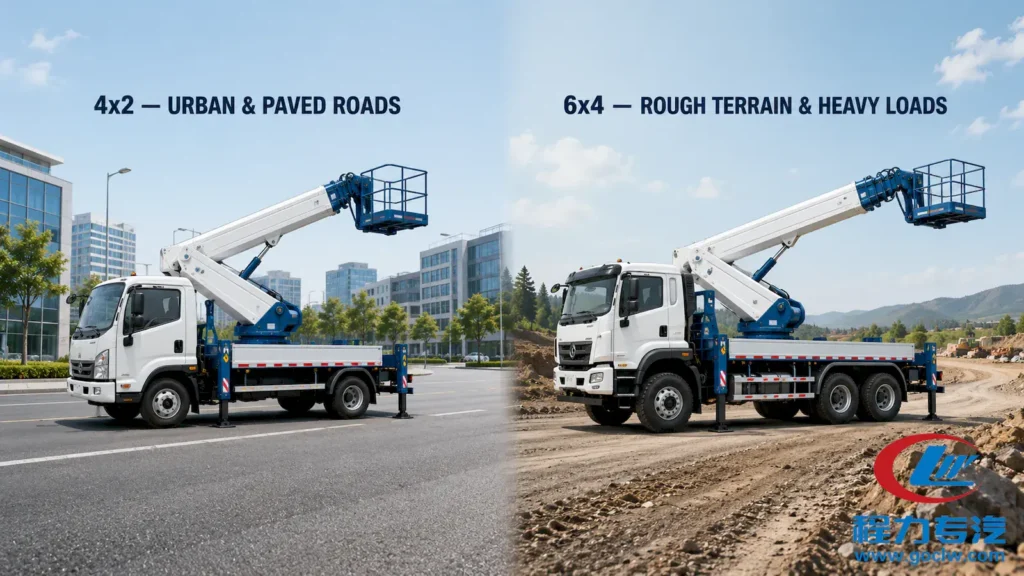
4×2 vs. 6×4 — Which Drive Configuration Fits Your Roads?
The drive configuration describes how many of the truck’s wheels are powered. A 4×2 has two driven wheels out of four; a 6×4 has four driven wheels out of six.
| Configuration | Best For | Trade-Offs |
|---|---|---|
| 4×2 | Paved roads, urban environments, light to medium booms (up to 28m) | Limited traction on unpaved or muddy roads |
| 6×4 | Unpaved roads, heavy booms (30m+), rough terrain, off-road job sites | Higher purchase price, higher fuel consumption |
If your service area is mostly within paved cities, a 4×2 will save you money every day. If your crews routinely drive on dirt roads, through rainy-season mud, or onto active construction sites, the extra traction of a 6×4 will pay for itself within two or three years of avoided downtime.
CLW supports chassis-and-boom matching as part of our standard pre-sales consultation. All vehicles are built in our 4,165-acre manufacturing base in Suizhou and are 100% pre-delivery tested before shipment.
Top 6 Real-World Applications of Aerial Work Platform Trucks
The fastest way to confirm whether you are looking at the right aerial work platform truck is to match it against the actual jobs your crews will perform every week. Below are the six most common application categories across our export markets, with the boom type, working height, and chassis class that most buyers in each scenario end up choosing.
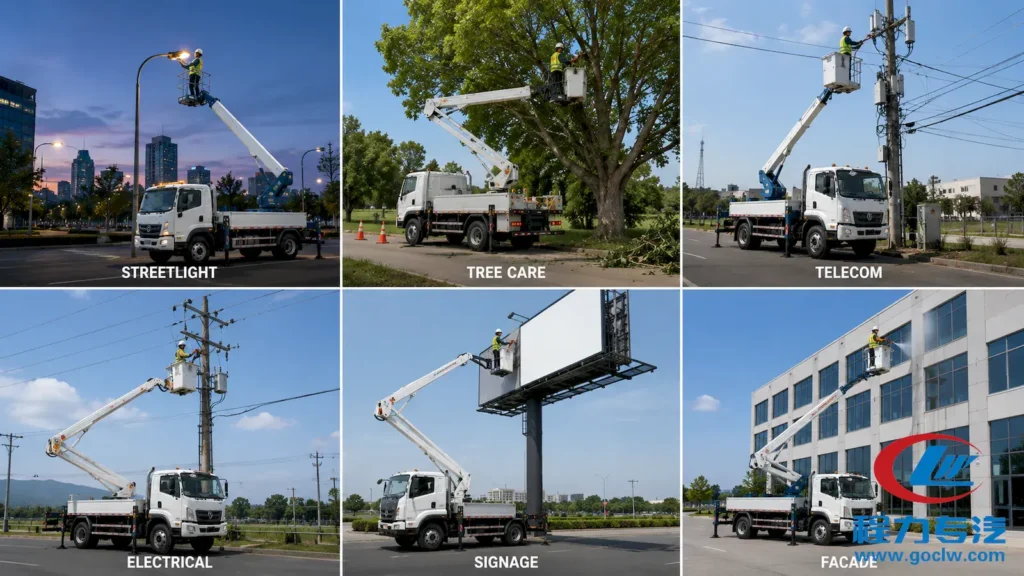
1. Municipal Streetlight Maintenance
This is the largest single application category across emerging markets. City governments need a reliable, road-legal vehicle that can move quickly between districts, deploy in under five minutes, and return to depot before traffic builds up.
- Recommended boom type: Telescopic or articulated, depending on whether streetlights sit close to traffic obstacles
- Working height: 14m – 18m
- Chassis class: Light-duty (Isuzu, JMC, Foton 4×2)
- Key features to specify: Compact outrigger footprint, basket-level controls, hydraulic emergency lowering
2. Tree Trimming and Vegetation Management
Roadside tree care is one of the most under-served municipal needs in tropical and subtropical regions. The right aerial work platform truck cuts crew injury risk dramatically while doubling daily output compared to ladder-based work.
- Recommended boom type: Articulated (knuckle) boom — essential for reaching over branches and into canopy areas
- Working height: 20m – 28m
- Chassis class: Medium-duty (Dongfeng, JAC, FAW)
- Key features to specify: 360° continuous boom rotation, reinforced basket guard, jib extension for fine positioning
3. Telecom Cable and Tower Installation
With 5G deployment and rural broadband expansion accelerating across South Asia, Southeast Asia, and Africa, telecom contractors need fleets that can handle both pole-mounted work and small tower installation.
- Recommended boom type: Telescopic for tower work, articulated for pole and cable work
- Working height: 18m – 28m
- Chassis class: Medium-duty 4×2
- Key features to specify: Tool tray on basket, 220V/110V outlets in basket, dual-operator capacity if installation requires two technicians
4. Electrical Utility Maintenance
Working on energized lines is a specialized application that requires more than a standard aerial work platform truck. Real safety depends on certified insulation, proper voltage ratings, and rigorous testing.
- Recommended boom type: Insulated bucket truck (telescopic or articulated insulated boom)
- Working height: 14m – 30m
- Chassis class: Light- to medium-duty
- Key features to specify: Documented dielectric voltage rating, dual insulation (boom + basket liner), insulated tool tray, regular re-testing program
A serious warning: If a supplier offers an “insulated” bucket truck without providing the specific voltage test certification and re-testing schedule, walk away. This is one of the most dangerous areas of the industry to cut corners.
5. Advertising and Signage Installation
Commercial signage work demands the ability to position the basket precisely against vertical surfaces — billboards above highways, large storefront signs, LED screens on building exteriors.
- Recommended boom type: Articulated (for offset positioning) or telescopic (for height-only signs)
- Working height: 16m – 28m
- Chassis class: Light- to medium-duty
- Key features to specify: Fine-movement proportional controls, basket leveling adjustment, jib for last-meter positioning
6. Building Façade Maintenance and Cleaning
Mid-rise commercial buildings — hotels, shopping centers, office towers up to 30m — represent a growing market for façade-cleaning contractors. A truck-mounted aerial work platform replaces dangerous suspended cradles for many tasks.
- Recommended boom type: Telescopic with jib, or articulated for buildings with balconies
- Working height: 24m – 33m
- Chassis class: Medium- to heavy-duty
- Key features to specify: Water tank and hose connection on basket, basket with sliding extension, large outrigger spread for stability
How to Source Aerial Work Platform Trucks from China (Without Getting Burned)
The Chinese special vehicle industry produces world-class equipment, but it also includes hundreds of small workshops repainting low-quality trucks for export. The difference between buying from a national-level manufacturer and a small trading company can be the difference between a 15-year asset and a vehicle that fails within 18 months. Here is how to tell the difference before you transfer your deposit.
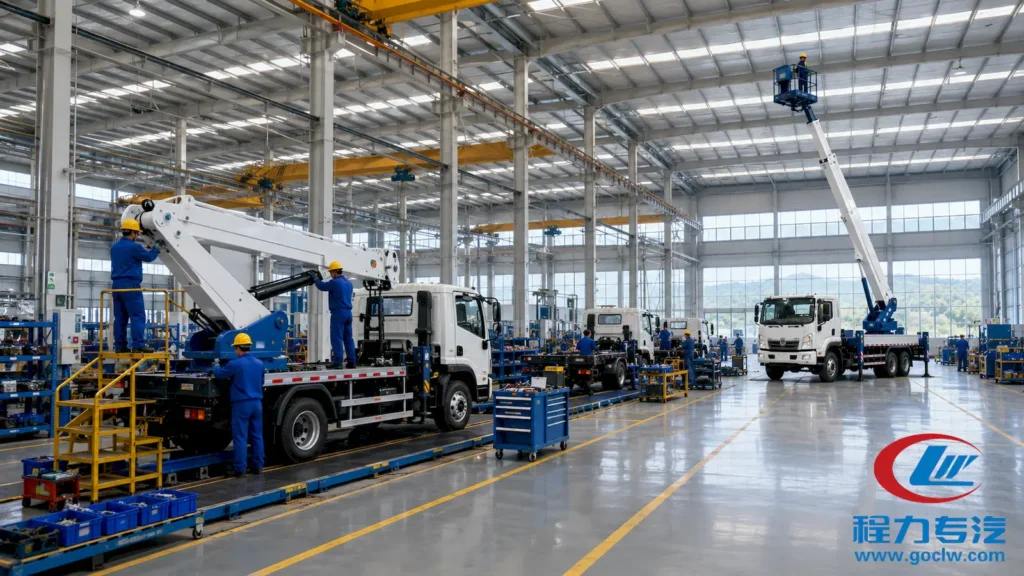
5 Red Flags When Comparing Chinese Manufacturers
After two decades of exporting to clients in 112+ countries, we have seen the same supplier failures repeat themselves. Watch for these five warning signs:
- No verifiable factory address or independent factory tour offer. Real manufacturers welcome video factory tours and on-site visits. Trading companies cannot.
- Vague chassis specifications. A legitimate supplier will tell you the exact chassis brand, model, engine type, emission standard, and transmission configuration. If they only say “Chinese chassis” or “Dongfeng-type,” that is a serious warning.
- No documented pre-delivery testing protocol. Every aerial work platform truck should be hydraulically tested, load tested, and safety inspected before leaving the factory — with photo or video evidence provided to the buyer.
- Certification claims without document numbers. “ISO certified” is meaningless without a certificate number you can verify with the issuing authority. The same applies to CCC and any other claimed standards.
- Unrealistic delivery promises. A properly built 28m aerial work platform truck takes time to assemble, test, and prepare for export. Promises of “10-day delivery” usually mean the supplier is selling stock units assembled without proper testing — or that the supplier doesn’t actually understand the work involved.
Why Buyers in 112+ Countries Choose CLW
CLW (Chengli Special Automobile Co., Ltd.) is a national-level special vehicle manufacturer appointed by China’s Ministry of Industry and Information Technology and recognized as one of the TOP 500 Chinese Private Enterprises. Our headquarters in Suizhou — China’s “Capital of Special Vehicles” — operates one of the largest specialized manufacturing bases in the industry.
What this means for overseas buyers:
| Capability | What You Get |
|---|---|
| 20+ years of manufacturing experience | A supplier that has solved the export problems you haven’t encountered yet |
| 4,165+ acres of manufacturing base | Real factory infrastructure, not a trading office |
| 8,000+ skilled employees across 38 specialized workshops | Dedicated production lines for specific vehicle types |
| 100,000 vehicle annual production capacity | The scale to meet large fleet orders and government tenders |
| 800+ vehicle models across 11 industry series | One supplier for your full special vehicle fleet, not just one product |
| Clients in 112+ countries | Documented export experience to your region — we have likely shipped to your country before |
| 100% pre-delivery testing | Every vehicle is hydraulically tested, load tested, and safety inspected before shipment |
Our quality system is certified to ISO 9001 and CCC standards, with additional certifications available for specific export markets. For government tenders and large fleet purchases, we provide all documentation required for customs clearance and local vehicle registration.
Customization, Compliance & Pre-Delivery Testing
Most overseas buyers underestimate how much customization a serious manufacturer can provide. CLW supports the following customization categories on our aerial work platform trucks:
- Drive position: Left-hand drive (LHD) or right-hand drive (RHD) for any market
- Emission standard: Euro 2, Euro 3, Euro 5, or local equivalent based on your country’s regulations
- Boom type and height: Telescopic, articulated, or hybrid configurations from 14m to 45m+
- Basket configuration: Single or dual operator capacity, custom tool tray, water connection, electrical outlets
- Chassis selection: Isuzu, JMC, Foton, Dongfeng, JAC, FAW, Sinotruk HOWO, Shacman, and others based on your operational needs
- Color and branding: Government livery, utility company colors, custom decals
- Documentation package: Bill of Lading, Commercial Invoice, Packing List, Certificate of Origin, ISO certificates, factory inspection report, and any market-specific certificates
Every aerial work platform truck undergoes a documented multi-stage testing process before leaving the factory: hydraulic pressure testing, full-extension load testing, outrigger stability verification, electrical system check, and final road test. Buyers receive a complete test report and inspection photos before shipment.
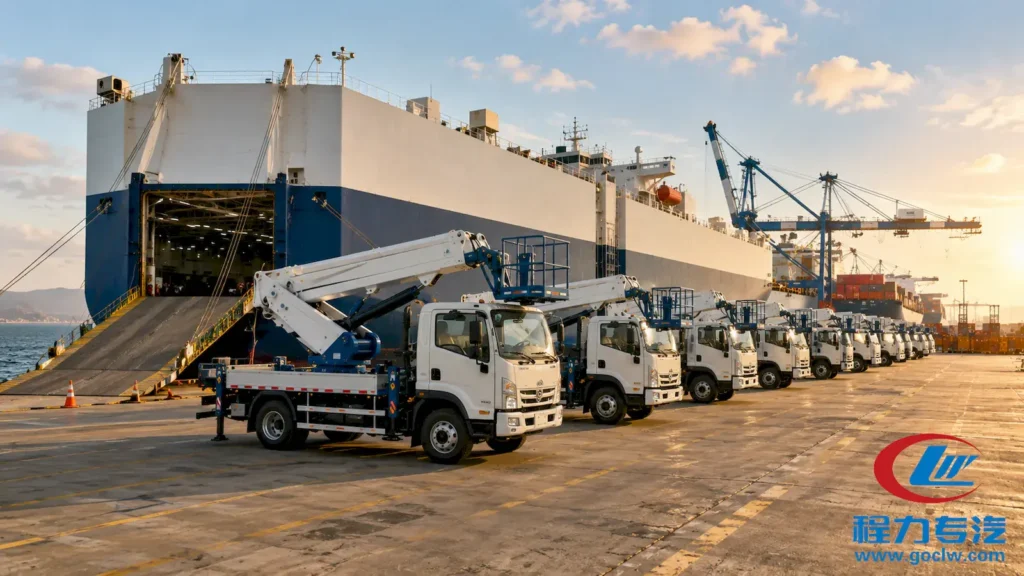
Shipping: Ro-Ro, Container, or Flat Rack?
Most aerial work platform trucks cannot fit inside a standard 40-foot container due to height, so the shipping decision usually comes down to two real options:
| Shipping Method | Best For | Lead Time | Cost |
|---|---|---|---|
| Roll-on/Roll-off (Ro-Ro) | Most aerial work platform trucks, single units, time-sensitive orders | Faster port-to-port | Lower per unit |
| Flat Rack Container | Routes without Ro-Ro service, fleet orders, ports with limited Ro-Ro capacity | Slightly longer | Slightly higher |
CLW coordinates shipping documentation and port handling for both methods. For buyers in Africa, Southeast Asia, the Middle East, and Latin America, we have established Ro-Ro routes to all major destination ports, with experienced freight forwarders who handle customs documentation and local clearance support.
Aerial Work Platform Truck FAQ
What is the difference between a boom lift and a bucket truck?
In practical export terminology, the two terms often overlap. A “boom lift” technically refers to any aerial work platform with a boom (whether self-propelled or truck-mounted), while a “bucket truck” specifically refers to a truck-mounted aerial work platform with a bucket-style basket — usually associated with electrical utility work. When a customer asks for a “bucket truck,” they almost always mean a truck-mounted aerial work platform, often with insulation for electrical work.
How much does an aerial work platform truck cost?
Pricing depends heavily on five factors: boom type, working height, chassis brand and class, level of customization, and destination port. Rather than quote a misleading “starting from” price, we recommend browsing our aerial work platform truck models to identify your preferred configuration, then sharing your application, working height requirement, preferred chassis, and destination country with our team for an accurate quotation tailored to your project.
What is the typical working height range available?
CLW manufactures aerial work platform trucks across the full range from 14m for compact urban work up to 45m+ for high-reach industrial and power utility applications. Custom configurations beyond 45m are available for specialized projects.
Can aerial platform trucks be customized for left-hand drive countries?
Yes. CLW manufactures both left-hand drive (LHD) and right-hand drive (RHD) configurations as standard. This is specified at the order stage and does not require special tooling — the chassis brands we work with all support both configurations.
What chassis is best for African road conditions?
It depends on the specific region and road profile. For paved urban environments in major African cities, medium-duty 4×2 chassis from Dongfeng or JAC are typically the best balance of cost and capability. For unpaved roads, mining areas, or oilfield service work, heavy-duty Sinotruk HOWO 6×4 platforms are more appropriate. Our team can recommend the right chassis based on your specific service area.
How long does production and shipping take?
Standard production lead time for an aerial work platform truck is typically 25 to 40 days from confirmed order and deposit, depending on configuration complexity and current factory schedule. Ocean shipping varies by destination: Southeast Asia is typically 10–18 days, the Middle East 18–25 days, East Africa 22–30 days, West Africa 30–40 days, and South America 35–45 days.
Are CLW aerial platform trucks ISO and CCC certified?
Yes. CLW is certified to ISO 9001 quality management standards and CCC (China Compulsory Certification). Specific aerial work platform trucks are also produced under the supervision of China’s Ministry of Industry and Information Technology (MIIT), which authorizes our production of national-list special vehicles. Additional market-specific certifications are available on request.
What documents are needed for customs clearance?
A standard CLW export documentation package includes: Commercial Invoice, Packing List, Bill of Lading, Certificate of Origin, ISO Certificate, CCC Certificate, factory inspection report, and pre-delivery test photos. For specific markets, we also provide insurance certificates, fumigation certificates (if required), and any country-specific homologation documents you need.
Ready to Specify Your Aerial Work Platform Truck?
Choosing the right aerial work platform truck is not about finding the cheapest unit on the market. It is about matching boom type, working height, and chassis class to the work your crews actually do — and partnering with a manufacturer that will support you for the full 10 to 15 years of the vehicle’s service life.
CLW has delivered aerial work platform trucks to clients in 112+ countries. Our 20+ years of manufacturing experience, 4,165-acre production base, and 100% pre-delivery testing protocol mean every vehicle is built to perform on day one — and every year after.
Looking to import an aerial work platform truck from China? Get a custom quote within 24 hours. Share your application, working height requirement, preferred chassis brand, and destination port — our team will recommend the right configuration and provide complete pricing within one business day.
📞 Contact Alvin, Export Director: +86 18371886000 (WhatsApp)
📧 Email: [email protected]
🌐 Explore our 800+ vehicle models: www.goclw.com