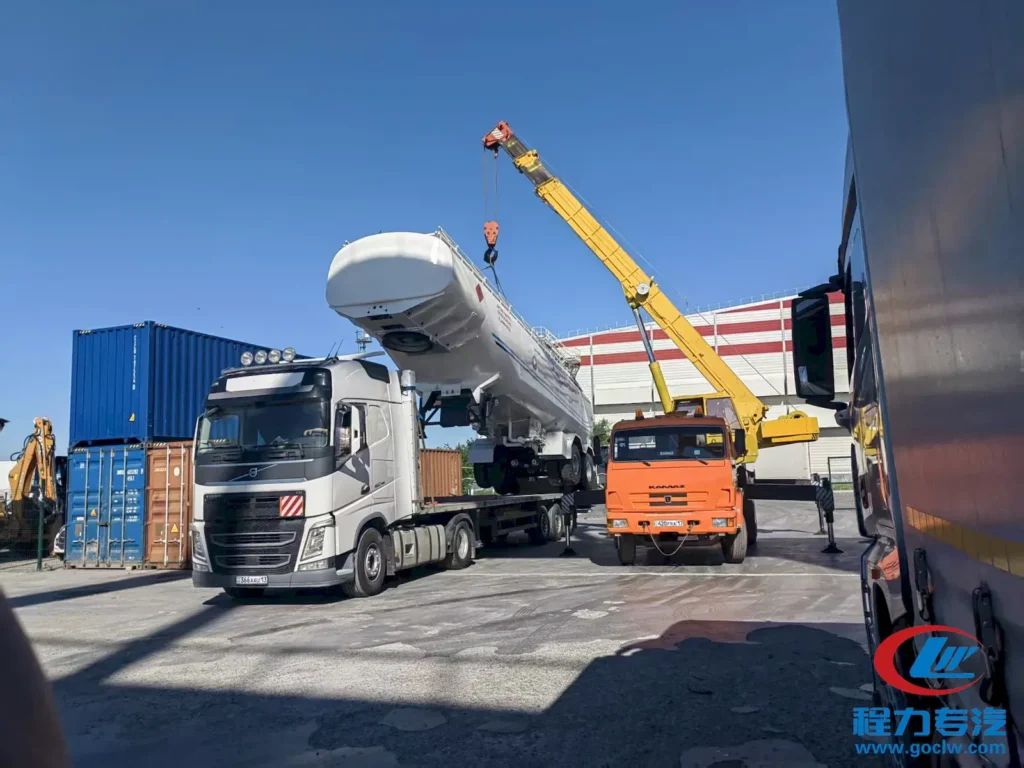
When Shymkent Airport in Kazakhstan set out to modernize its apron fueling fleet, it needed more than an off-the-shelf tanker. It needed a purpose-built aircraft refueling truck designed for the climate, the fuel grades, and the operating standards of Central Asia — and it needed several of them, on a predictable schedule. As the appointed export partner, Chengli Special Automobile Co., Ltd. (CLW Group) engineered and manufactured a fleet of four 45,000L aircraft refueling trucks, with the first unit already delivered and three more currently in production.
This case study walks through the full project: the airport’s requirements, the engineering decisions behind the build, the complete technical specifications, and the international standards the fleet was designed to. If you are evaluating an aircraft refueling truck for an airport, FBO, or fuel-services operation, this is a detailed look at what a customized, export-ready solution actually involves.
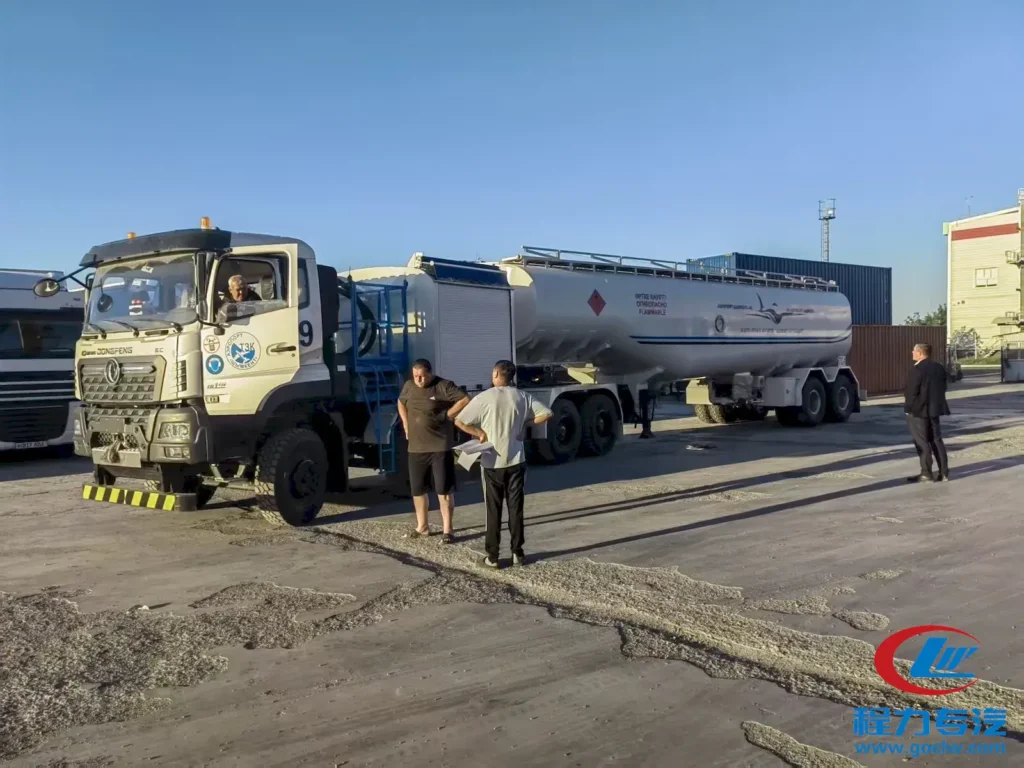
The Project: Four Aircraft Refueling Trucks for a Kazakhstan Airport
Shymkent is one of Kazakhstan’s busiest regional aviation gateways, and into-plane fueling sits on the critical path of every turnaround. A delay at the fuel stage delays the aircraft, so the airport’s brief centered on three things: capacity, reliability, and compliance.
The requirement was specific. Each aircraft refueling truck had to:
- Carry a large volume of Jet A-1 / TS-1 (ТС-1) aviation kerosene to minimize trips back to the fuel farm.
- Operate dependably in the wide seasonal temperature swings and the apron conditions typical of the CIS region.
- Be built to the aviation fuel-handling standards that airports in Kazakhstan expect.
- Be delivered as a matched fleet, so every unit is identical for training, spare parts, and maintenance.
CLW’s answer was a fleet of four identical 45,000-liter aircraft refueling trucks, each engineered around speed of service and fuel-quality assurance. Rather than convert a standard road tanker, our engineering team built each unit on a dedicated aircraft-refueling chassis — a decision we explain in the specifications section below, because it has a direct impact on performance.
The first unit has already entered service at the airport. The remaining three are on the production line now, with the full four-unit fleet scheduled for completion in approximately six months from order. For airport buyers, that combination — large capacity, full customization, and a realistic multi-unit lead time — is exactly what separates a serious manufacturer from a trader.
You can explore our full range of aircraft refueling trucks in capacities from 5,000 to 50,000 liters.
Technical Specifications of the 45,000L Aviation Refueler
Every unit in the Shymkent fleet shares the same core configuration. The table below summarizes the specifications buyers ask about most when sourcing an aircraft refueling truck.
| Specification | Detail |
|---|---|
| Tank capacity | 45,000 L (45 CBM), single compartment |
| Tank material | Aluminium alloy — lightweight, corrosion-resistant |
| Chassis | Purpose-built heavy-duty aircraft-refueling chassis, extended wheelbase |
| Drive / terrain | Off-road-capable, suited to unpaved and rough aprons |
| Fuel type | Jet A-1 / TS-1 (ТС-1) aviation kerosene |
| Refueling modes | Dual mode — pressure (underwing) and gravity (overwing) |
| Pump | Centrifugal pump, max flow rate 3,000 L/min |
| Fueling hoses | EI 1529-compliant aviation fueling hoses |
| Filtration | Filter-water separator, performance complies with API 1581 |
| Metering | High-precision flow meter, accuracy Class 0.2 |
| Elevating platform | Liftable platform, max height up to 4,200 mm |
| Pressure control | Deadman pressure control valve |
| Safety systems | Vapor recovery, anti-overflow probe, complete aviation-grade safety package |
| Standards | Built to JIG-aligned standards |
At the heart of each unit is a centrifugal pump rated at 3,000 L/min, paired with an API 1581-compliant filter-water separator and a Class 0.2 high-precision flow meter — the combination that ensures both fast turnaround and clean, accurately metered fuel delivery. A Deadman pressure control valve and a liftable platform reaching up to 4,200 mm complete a fully operator-ready refueling system.
Why this aircraft refueling truck does not use a tractor unit
A common question from buyers is why a refueler this large is not built on a standard tractor-trailer. The answer comes down to wheelbase. A standard tractor unit is simply too short to carry the full fueling system — pump, filter-water separator, flow meter, hose reels, and the operating platform all need to be mounted in line. A purpose-built aircraft-refueling chassis with an extended wheelbase provides the length, weight distribution, and stability that the equipment demands.
The build is also off-road-capable. Regional airports across Central Asia, Africa, and the Middle East often have aprons and access roads that are not uniformly paved, and an aircraft refueling truck that can operate confidently on rough ground is far more useful than one limited to perfect surfaces. This is one of the most common reasons buyers in these markets choose a heavy-duty chassis over a lighter commercial one.
Aluminium Alloy vs Carbon Steel: Choosing the Right Tank Material
Tank material is one of the first decisions in any aircraft refueling truck build, and the Shymkent fleet uses aluminium alloy for clear operational reasons.
| Factor | Aluminium alloy (used here) | Carbon steel |
|---|---|---|
| Weight | Lighter — more payload, lower fuel burn | Heavier |
| Corrosion resistance | High, important for fuel purity | Requires lining/coating |
| Fuel cleanliness | Excellent for aviation kerosene | Good with proper internal treatment |
| Typical use | Aviation refuelers, high-spec fuel work | General fuel and road tankers |
For aviation fuel, where cleanliness and weight both matter, aluminium alloy is the standard choice — and it is why every unit in this fleet uses it. Buyers with different priorities can still specify carbon steel for other applications; we cover the full range in our custom fueling vehicle builds.
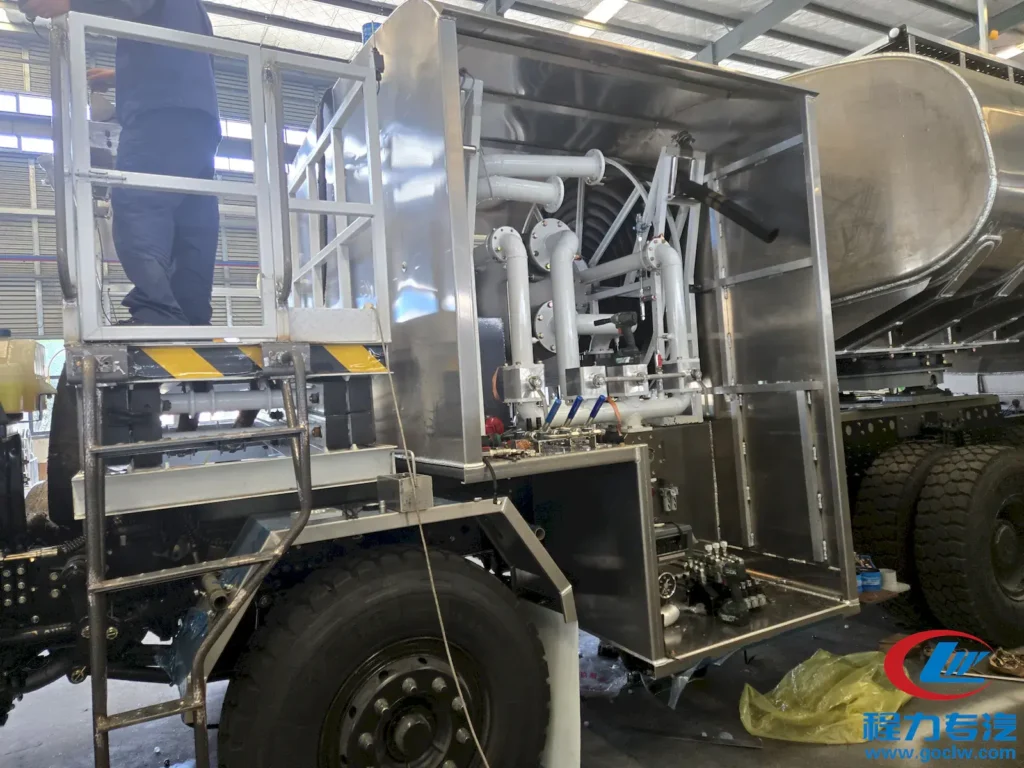
Pressure vs Gravity Refueling: Why This Aircraft Refueling Truck Supports Both
Aircraft can be fueled in two ways, and the Shymkent units are built to do both from a single vehicle.
- Pressure (underwing) refueling pushes fuel into the aircraft’s tanks under pressure through one connection point beneath the wing. It is fast, clean, and the standard method for larger commercial aircraft.
- Gravity (overwing) refueling delivers fuel through a nozzle into the top of the wing tank, similar to filling a car. It is used for smaller aircraft and at locations where pressure fueling is not available.
| Pressure (underwing) | Gravity (overwing) | |
|---|---|---|
| Speed | Faster | Slower |
| Best for | Commercial / larger aircraft | Small aircraft, general aviation |
| Connection | Single underwing point | Overwing nozzle |
| Included on this truck | Yes | Yes |
By supporting both modes, each aircraft refueling truck can service a wide mix of aircraft — from regional jets to general aviation — without the airport needing separate equipment. This dual-mode flexibility is one of the most-requested features we build, and for an airport with varied traffic it is a meaningful cost saving.
Built to JIG-Aligned Standards for the CIS Market
Aviation fuel quality is governed by internationally recognized standards, and the Shymkent fleet was configured accordingly from the design stage. Each aircraft refueling truck is built to JIG-aligned standards and fitted with EI 1529-compliant fueling hoses — the international specification for aviation fuelling hose and hose assemblies published by the Energy Institute.
This matters because airports in Kazakhstan and across the wider CIS region operate to globally recognized fuel-handling practices. Designing to these standards from the outset — rather than retrofitting after the fact — means the equipment integrates cleanly into existing airport fueling procedures, with no surprises at commissioning. For broader context on fuel quality control in airport operations, the International Air Transport Association (IATA) publishes extensive industry guidance.
Beyond aviation-specific requirements, every CLW vehicle is manufactured under our ISO, ASME, ADR, and EU-aligned quality systems, giving buyers documented assurance across the entire build — not just the fueling components.
Why Airports Choose CLW Aircraft Refueling Trucks
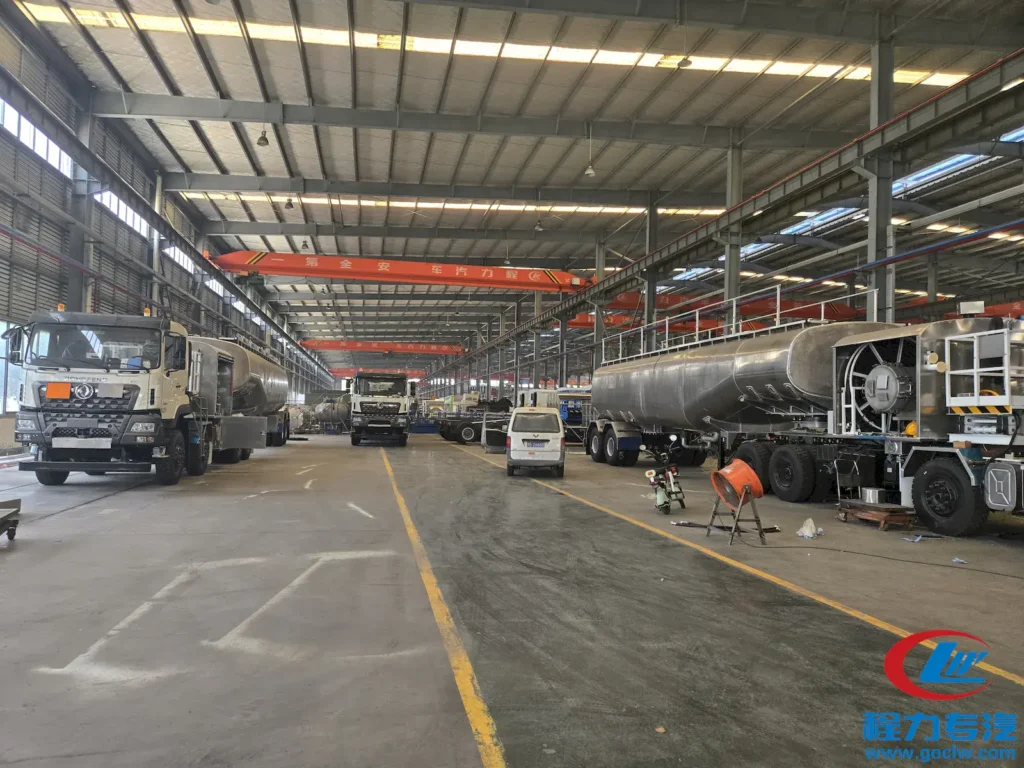
CLW is one of China’s leading special-vehicle manufacturers, and the Shymkent project reflects the scale behind every order:
- 20+ years of special-vehicle manufacturing experience
- 800+ models across 11 industry series, including a complete aviation refueling line
- 8,000+ employees and 38 specialized workshops on a 4,165+ acre manufacturing base
- Exported to 112+ countries, trusted by 10,000+ clients worldwide
- 100% pre-delivery tested before every shipment leaves the factory
For airport and aviation-fuel buyers, this translates into three practical advantages. First, deep customization — single-compartment, aluminium, dual-mode, JIG-aligned, exactly as the airport specified. Second, reliable lead times even on multi-unit fleet orders, because the manufacturing capacity is real and in-house. Third, cost-effective pricing compared with European or American manufacturers — typically 30–50% lower for an equivalent specification, without cutting the standards that matter.
That balance of price and capability is why the aircraft refueling truck has become one of our most-requested aviation products. You can read more about CLW and our manufacturing capability.
Frequently Asked Questions
What is the capacity of CLW’s aircraft refueling trucks? Capacities range from 5,000 to 50,000 liters. The Shymkent fleet uses 45,000-liter single-compartment aluminium alloy tanks.
Can the aircraft refueling truck handle both Jet A-1 and TS-1 fuel? Yes. The units are configured for Jet A-1 and TS-1 (ТС-1) aviation kerosene, the grades used across the CIS region.
Why is the refueler built on a special chassis instead of a tractor unit? A standard tractor unit is too short to mount the full fueling system. A purpose-built aircraft-refueling chassis with an extended wheelbase provides the length, stability, and off-road capability the equipment requires.
What is the lead time for a fleet order? The four-unit Shymkent order was scheduled for approximately six months from order to full fleet completion. Single units are faster; large fleets are quoted case by case.
Does the truck support pressure and gravity refueling? Yes. Each unit supports both pressure (underwing) and gravity (overwing) refueling in a single vehicle.
Which standards is the aircraft refueling truck built to? Each unit is built to JIG-aligned standards with EI 1529-compliant fueling hoses, under CLW’s ISO, ASME, ADR, and EU-aligned quality systems.
Can the truck be customized for my airport’s requirements? Yes. Capacity, tank material, fueling modes, pump rate, and onboard equipment are all customizable to local fuel grades and operating standards.
Looking to import a 45,000L aircraft refueling truck — or a custom fleet — from China? Get a tailored quote within 24 hours. Contact Alvin at +86 18371886000 (WhatsApp) or [email protected], or visit www.goclw.com to explore our 800+ vehicle models.