
If you are planning to build or maintain roads in Africa, Southeast Asia, the Middle East, South Asia, or Latin America, choosing the right bitumen sprayer truck can make or break your project budget. The wrong truck means uneven spray, wasted bitumen, costly downtime, and angry crews. The right truck pays for itself within two or three large jobs.
This guide is written for contractors, government procurement officers, and equipment dealers who need to understand bitumen sprayer trucks before signing a purchase order. We will cover how they work, what specifications actually matter, how to match the truck to your market, and what to expect on price. We will also share what 20 years of exporting special vehicles to 112+ countries has taught us about helping buyers avoid expensive mistakes.
What Is a Bitumen Sprayer Truck and How Does It Work?
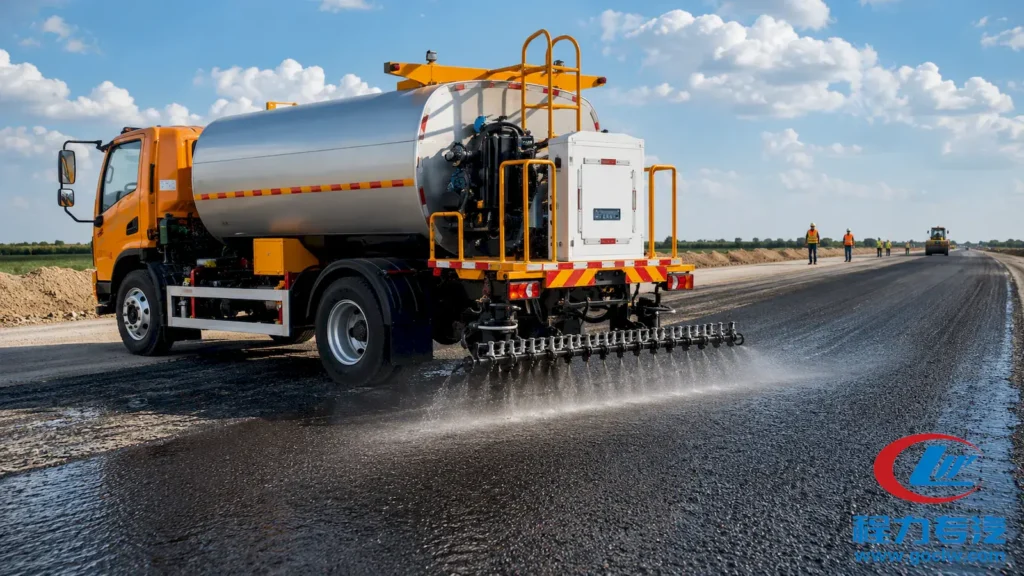
A bitumen sprayer truck — also called an asphalt distributor truck, bitumen distributor, or asphalt sprayer — is a specialised road construction vehicle designed to heat liquid bitumen and spray it uniformly onto a road surface. It is the machine responsible for creating the bonding layer between pavement structures, the protective seal coat on finished roads, and the foundation treatment on new road bases.
Without a bitumen sprayer truck, contractors would have to apply bitumen by hand — slow, uneven, and labour-intensive. With one, a crew of two operators can prime several kilometres of road surface in a single shift.
Core Function and Working Principle
The working principle is straightforward but requires precise control. The truck draws bitumen from a storage facility into its insulated tank, then transports it to the construction site. On site, a heating system — usually a diesel burner combined with a thermal oil circulation system — maintains the bitumen at the correct working temperature, typically between 140°C and 180°C, so that it stays liquid and sprayable.
When the operator activates the spray system, a high-pressure bitumen pump pushes the heated bitumen through a horizontal spray bar mounted at the rear of the truck. The spray bar contains a row of nozzles spaced precisely to create a uniform triple-overlapping spray pattern across the road surface. As the truck drives forward at a controlled speed, the result is a perfectly even layer of bitumen — applied at the exact rate the engineer specified, measured in litres per square metre.
Key Components Inside a Modern Distributor Truck
A modern bitumen sprayer truck is built around seven core systems working together:
| Component | Function |
|---|---|
| Insulated bitumen tank | Stores bitumen and minimises heat loss during transport and standby |
| Diesel burner & heating system | Heats bitumen to working temperature; thermal oil circulation maintains stability |
| Bitumen pump | Draws bitumen from storage, circulates it during heating, and pressurises it for spraying |
| Spray bar with nozzles | Distributes bitumen evenly across the road; width adjustable from 2 m to 6 m typically |
| Hydraulic system | Powers spray bar folding, nozzle opening, and auxiliary functions |
| Pneumatic system | Controls nozzle on/off via compressed air, allowing instant spray cut-off |
| Electronic control system | Manages spray rate, pressure, vehicle speed coordination, and safety interlocks |
The bitumen tank is the heart of the truck. Quality is determined by steel grade (Q235 carbon steel is the international standard), wall thickness (typically 6-8 mm), insulation material (usually 50-100 mm of rock wool with stainless steel outer cladding), and the cleanliness of internal welds, which directly affect bitumen flow and corrosion resistance.
Manual vs. Intelligent Computer-Controlled Systems
Bitumen sprayer trucks come in two main control configurations, and choosing between them has a major impact on both price and operational quality.
Manual / semi-automatic systems rely on the operator to set spray rate by adjusting pump speed and vehicle speed. They are cheaper, easier to repair in remote areas, and well-suited to lower-volume work or markets where skilled electronics technicians are scarce. The trade-off is that spray uniformity depends entirely on operator skill — and inconsistent application wastes expensive bitumen.
Intelligent / computer-controlled systems use a PLC controller that measures vehicle speed in real time and automatically adjusts pump rotation to maintain a constant litres-per-square-metre application rate, regardless of how the truck is moving. The operator simply enters the target spray rate, width, and bitumen type, then drives. The computer handles the rest. These systems cost 15-25% more upfront but typically pay for themselves through bitumen savings within the first year of heavy use, especially on government and large-scale projects where spray rate compliance is audited.
Main Applications: From Prime Coat to Chip Seal
A bitumen sprayer truck is far more versatile than its name suggests. The same truck — sometimes with minor nozzle adjustments — can perform four distinct road construction operations.
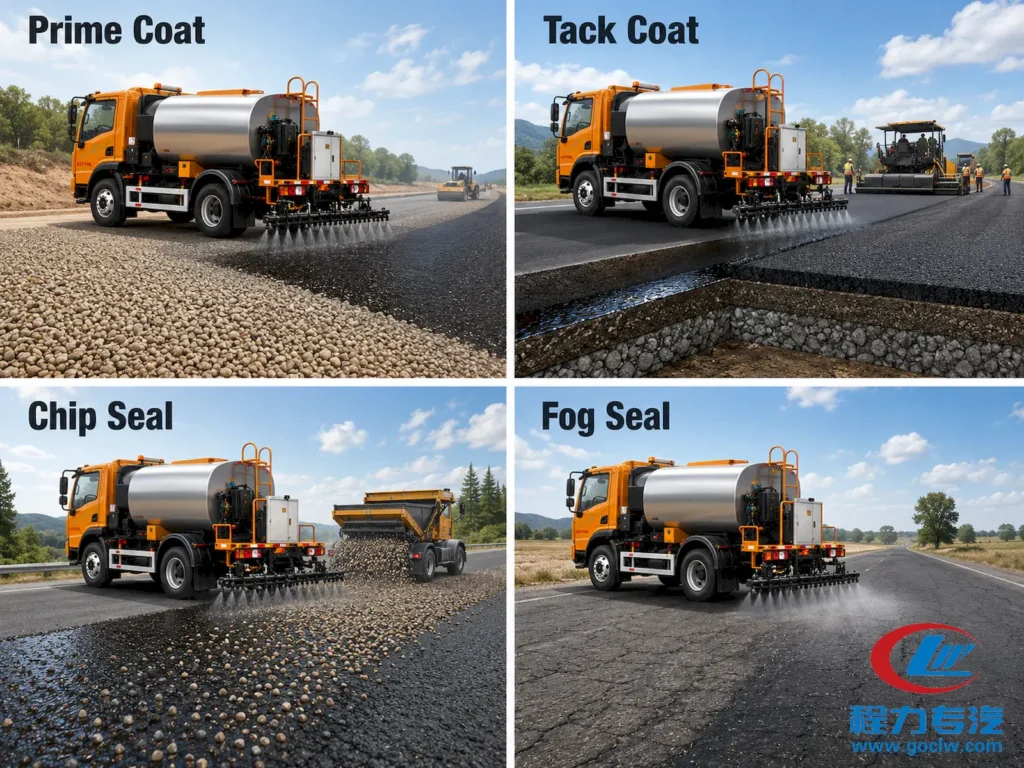
Prime Coat Application
Prime coat is the first bituminous layer applied to a newly prepared granular base. Its purpose is to penetrate into the base, bind loose particles together, and create a moisture barrier before the asphalt pavement is laid on top. Prime coat application requires a slower, heavier spray — typically 0.8 to 1.5 L/m² — using cutback or medium-curing emulsified bitumen. Bitumen sprayer trucks used for prime coating need strong penetration capability and accurate low-speed spray control.
Tack Coat Application
Tack coat is the thin bituminous layer sprayed between two asphalt layers to ensure they bond together as a single structural unit. Without proper tack coating, asphalt layers can slip, crack, and fail prematurely. Tack coat application is fast and light — typically 0.2 to 0.5 L/m² — using emulsified bitumen. The bitumen sprayer truck must apply this thin layer with exceptional uniformity, since over-spraying wastes material and under-spraying compromises bond strength.
Chip Seal and Surface Dressing
Chip seal — also called surface dressing — is a cost-effective road maintenance technique where bitumen is sprayed onto an existing road and immediately covered with aggregate chips. It is especially popular in Africa, Australia, and rural infrastructure projects across South Asia and Latin America because it extends pavement life by 5-7 years at a fraction of the cost of repaving. Chip seal requires heavy spray rates (1.0 to 2.0 L/m²) and is often performed in coordination with a chip spreader following directly behind the sprayer truck.
Fog Seal, Sand Seal, and Other Maintenance Applications
The same bitumen sprayer truck can also perform fog sealing (a light coat of diluted emulsion applied to seal minor cracks on an aged surface), sand sealing, and waterproofing of bridge decks and concrete structures. This multi-application capability is precisely why bitumen sprayer trucks are core fleet equipment for road maintenance authorities and contractors — one machine handles the full lifecycle of a road, from construction to long-term maintenance.
Bitumen Sprayer Truck Specifications Explained
Reading a bitumen sprayer truck spec sheet is the single most important skill a buyer can develop. Here is what actually matters — and what is just marketing.
Tank Capacity: Match to Project Scale
Tank capacity is measured in litres or cubic metres (CBM) and determines how much road you can spray before refilling. Choosing the right capacity is a balance between productivity and chassis cost — bigger tanks need bigger, more expensive chassis.
| Tank Capacity | Typical Use Case | Recommended Chassis |
|---|---|---|
| 4,000 L (4 CBM) | Urban maintenance, small roads, patch repairs | ISUZU, JAC, light Dongfeng 4×2 |
| 5,000 – 6,000 L | Mid-size contractor work, secondary roads | Dongfeng 4×2, FAW 4×2 |
| 8,000 L (8 CBM) | Highway and provincial road projects | Sinotruk HOWO 6×4, Shacman 6×4 |
| 10,000 – 13,000 L | National highway, large-scale infrastructure | Sinotruk HOWO 8×4, Shacman 8×4, trailer-mounted |
A common mistake is over-buying. A contractor doing mostly urban tack coat work does not need a 10,000 L truck — the larger tank cools faster between jobs, wastes diesel keeping bitumen hot, and is harder to manoeuvre on narrow roads.
Chassis Selection: The Foundation of Long-Term Reliability
The chassis carries the entire upper body and determines the truck’s road performance, fuel economy, and parts availability in your country. For export markets, five chassis brands dominate:
- ISUZU — Premium choice. Highest reliability, excellent fuel economy, widely available parts. Best for buyers in Southeast Asia, Middle East, and parts of Africa where ISUZU dealer networks exist. Higher upfront cost.
- Dongfeng — Excellent balance of quality and price. Strong global parts network. Popular across Africa and Southeast Asia for medium-duty applications.
- Sinotruk HOWO — China’s heavy-duty workhorse. Proven in African mining and infrastructure for over 15 years. Excellent for 8 CBM and larger trucks. Affordable parts.
- Shacman — Strong heavy-duty performance, particularly popular in Central Asia, Russia-speaking markets, and parts of Latin America.
- FAW — Reliable, mid-priced, broad model range. Good general-purpose choice.
Buyer’s tip: Before choosing a chassis, ask your supplier which brands have authorised service dealers and parts stockists in your country. A cheaper chassis with no local parts support becomes the most expensive chassis when it breaks down 200 km from the capital.
Spray Bar Width and Nozzle Configuration
Spray bar width determines how wide a strip of road you can treat in a single pass. Standard width is 4 metres, expandable to 6 metres for highway applications. The spray bar should fold hydraulically for road transport — a fixed wide spray bar will not be legal on most highways.
Nozzle design matters more than buyers realise. Look for:
- Adjustable angle nozzles (typically 30°) for true triple-overlap spray pattern
- Individual nozzle on/off control so you can spray any combination of widths from 1.5 m to full bar width
- Diesel-and-compressed-air cleaning system that automatically purges nozzles after each job to prevent freezing or clogging
- Stainless steel or alloy construction for corrosion resistance
Heating System and Insulation Performance
The heating and insulation specifications determine how efficiently the truck operates over a full working day.
| Specification | What Good Looks Like |
|---|---|
| Burner type | Diesel-fired automatic burner with electronic ignition |
| Heating method | Thermal oil circulation (preferred) — heats indirectly, prevents bitumen scorching |
| Heat-up time | From 20°C to 160°C in under 90 minutes for a 5,000 L tank |
| Heat loss | Temperature drop ≤ 12°C in 8 hours at ambient room temperature |
| Insulation | 50-100 mm rock wool with stainless steel outer cladding |
| Temperature control | Automatic thermostatic control with digital display |
Poor insulation forces operators to run the burner more often, wasting fuel and putting heat stress on the tank. Cheap trucks cut corners here — always ask for the heat loss specification in writing.
Pump, Burner, and Control System Brands
The single best predictor of long-term reliability is the brand of the key components — not the brand on the truck door. Reputable manufacturers will use:
- Bitumen pump: international brands or top-tier Chinese brands rated for 60-80 GPM equivalent flow
- Diesel burner: Beckett (USA), Riello (Italy), or equivalent
- PLC controller: Siemens, Mitsubishi, or Schneider for intelligent models
- Hydraulic pump and motor: Rexroth, Parker, or equivalent
If a supplier refuses to disclose component brands, that is a warning sign.
How to Choose the Right Bitumen Sprayer Truck for Your Market
The “best” bitumen sprayer truck depends entirely on where it will work. A truck built for Saudi Arabia will struggle in Ethiopia. A truck optimised for Chilean cold chain logistics will overheat in Indonesia. Here is how to think about the decision.
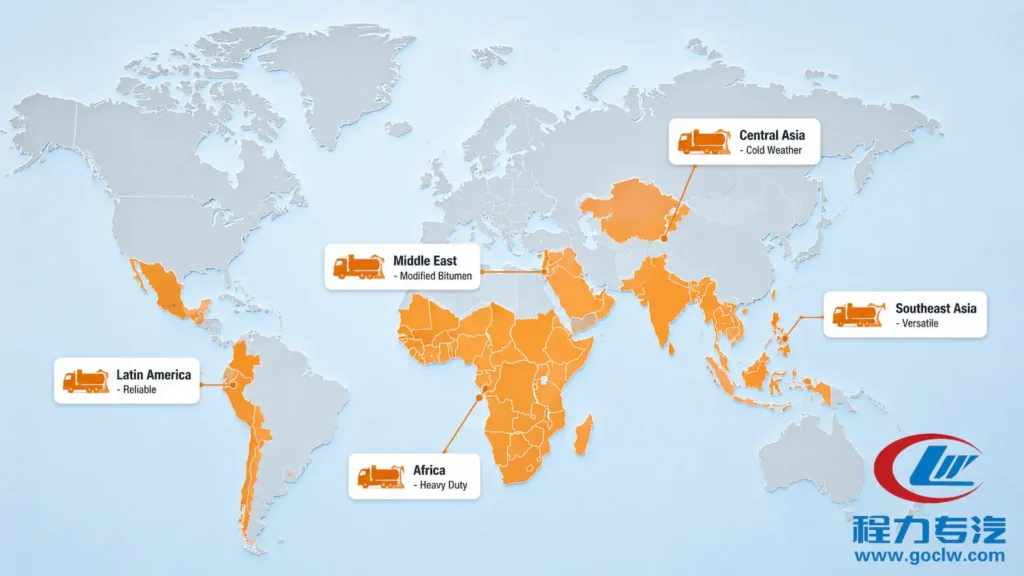
For Africa: Heavy Duty, Dust Resistant, Easy to Maintain
African road projects typically involve long-distance hauls between bitumen depots and construction sites, hot ambient temperatures, dusty environments, and limited local technical support. The right truck here is a Sinotruk HOWO 6×4 or Shacman 6×4 chassis with 8,000 L tank, semi-automatic control (simpler to repair), heavy-duty air filtration, and reinforced suspension. Avoid over-complicated electronics — prioritise components that local mechanics can troubleshoot. Parts inventory at delivery time matters: insist on a 1-year spare parts package.
For Southeast Asia: Mid-Size Capacity, Versatile Applications
Southeast Asian buyers — Vietnam, Indonesia, Philippines, Thailand — typically work on mixed projects: urban roads, highways, and rural connections. A versatile Dongfeng 4×2 or Sinotruk HOWO 4×2 with 5,000 to 6,000 L tank and intelligent computer-controlled spray system suits most needs. Humidity is a factor — specify upgraded corrosion protection on tank exteriors and electronics enclosures.
For the Middle East: Heat Tolerance and Modified Bitumen Capability
Middle Eastern projects — Saudi Arabia, UAE, Iraq, Oman — face extreme ambient temperatures and increasingly use polymer-modified bitumen (PMB) for highway construction. Trucks for this market need upgraded high-viscosity pumps, enhanced thermal oil heating systems capable of handling PMB at 180-190°C, and larger tank capacity (10,000 L or trailer-mounted 12,000+ L). Premium chassis like ISUZU or Shacman X3000 are common.
For South Asia and Latin America: Reliable, Cost-Effective, Strong Parts Supply
For Bangladesh, Pakistan, Sri Lanka, Chile, Peru, and similar markets, the priority is proven reliability at a competitive price point. Mid-size 6,000 to 8,000 L trucks on Dongfeng or Sinotruk HOWO chassis dominate. The decisive factor is often the supplier’s ability to deliver spare parts within 7-14 days — this should be a written contractual commitment.
For Central Asia and Russian-Speaking Markets
Cold-weather operation is the differentiator. Trucks for Uzbekistan, Kazakhstan, and similar markets need enhanced insulation, cold-start diesel burners, antifreeze hydraulic fluids, and cabin heating upgrades. Shacman and FAW chassis are well-suited to these conditions.
Bitumen Sprayer Truck Price: What Drives the Cost?
Bitumen sprayer truck prices for export typically range from USD 30,000 to USD 150,000+, depending on configuration. Here is how that price is built up.
The Six Major Cost Drivers
| Cost Driver | Impact on Price |
|---|---|
| Tank capacity | Largest single factor — every additional 2,000 L adds USD 6,000-12,000 |
| Chassis brand and configuration | Premium chassis (ISUZU, Shacman X3000) add USD 8,000-20,000 over standard |
| Control system | Intelligent PLC system adds USD 6,000-15,000 over semi-automatic |
| Component brands | Imported pumps, burners, valves add USD 4,000-10,000 |
| Customisation | PMB capability, special insulation, multi-language displays add USD 3,000-15,000 |
| Certifications & compliance | EU compliance, special homologation can add USD 2,000-8,000 |
China vs. Europe/USA: Cost-Performance Reality Check
A like-for-like bitumen sprayer truck — same tank capacity, same control system, comparable component quality — typically costs 30-50% less when sourced from a reputable Chinese manufacturer than from European or American brands. The reasons are structural: China has the world’s largest road construction equipment supply chain, lower labour costs, and intense domestic competition that drives constant improvement.
The right question is not “Is the Chinese truck cheaper?” — it is “Is the Chinese manufacturer reputable, financially stable, ISO-certified, and committed to after-sales support?” A reputable Chinese supplier delivers equivalent performance at significantly lower cost. A poor one delivers something that looks the same but breaks down within months.
Hidden Costs Buyers Often Forget
Before signing a contract, factor in:
- Sea freight — typically USD 2,500-6,000 per truck depending on origin port, destination, and chassis size
- Import duty and VAT — varies widely by country (10-35% common range)
- Spare parts inventory — budget 5-8% of truck cost for a 1-year starter parts package
- Operator training — some suppliers include 3-7 days of factory training; others charge USD 2,000-5,000
- Local customs clearance and inland transport — varies by country
A trustworthy supplier will help you forecast these costs upfront, not hide them.
Why Buy Your Bitumen Sprayer Truck from CLW Group
Chengli Special Automobile Co., Ltd. (CLW Group) is a TOP 500 Chinese private enterprise headquartered in Suizhou — known across the industry as China’s “Capital of Special Vehicles.” We have manufactured special vehicles for over 20 years and currently deliver to 10,000+ clients in 112+ countries.
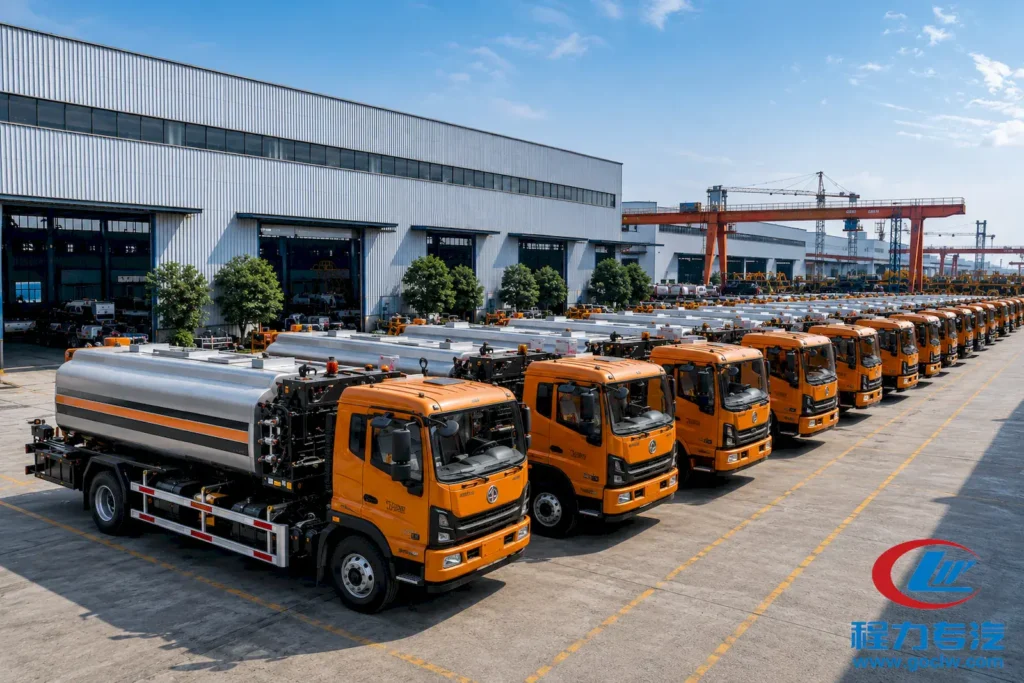
Here is what that means in practice for buyers of bitumen sprayer trucks.
Manufacturing Scale and Capability
- 4,165+ acres of manufacturing base in Suizhou
- 38 specialised workshops with dedicated lines for tank fabrication, chassis modification, and final assembly
- 8,000+ skilled employees including engineers specialising in road construction equipment
- Annual capacity of 100,000 special vehicles across 800+ customisable models
- 100% pre-delivery testing on every truck before it leaves the factory
International Certifications
CLW Group is certified to internationally recognised standards including:
- ISO 9001 quality management system
- ASME for pressure vessel manufacturing
- EU certification for export compliance
- CCC (China Compulsory Certification)
- Appointed by China’s Ministry of Industry and Information Technology (MIIT) as a national-level special vehicle manufacturer
Real Export Track Record
Our export experience extends across the markets that matter most for bitumen sprayer truck buyers:
- Africa: Sinotruk HOWO-based special vehicles delivered to Ghana, Tanzania, and multiple other countries — proving our capability with the chassis and configurations most relevant to African road construction
- Southeast Asia: Multi-vehicle fleet projects delivered to Vietnam, including high-end specialised equipment
- Latin America: 40-unit refrigerated vehicle fleet delivered to Chile in 2026
- South Asia: 60-unit ambulance fleet delivered in 30 days to a government Ministry of Health — a benchmark for rapid, large-scale delivery
Cost Advantage Without Compromise
CLW Group bitumen sprayer trucks typically offer 30-50% cost savings compared to European or American manufacturers for equivalent specifications, made possible by our scale, vertical integration, and the supply chain strength of “Suizhou Special Vehicle Capital.” The savings come from manufacturing efficiency — not from cutting corners on tank steel, insulation, or component quality.
Maintenance and After-Sales Support
A bitumen sprayer truck is a 10-15 year asset. The supplier you choose is your partner for that entire period — not just for the day the truck ships.
What to Expect from a Quality Supplier
Before delivery:
- Detailed pre-shipment inspection report with photos and video
- Operator and maintenance manuals in your language
- Spare parts kit recommendation tailored to your project workload
At delivery:
- Truck arrives with all consumables filled (hydraulic oil, thermal oil, lubricants)
- Commissioning checklist signed off jointly
During the first year:
- Remote technical support via WhatsApp, email, or video call
- Access to factory engineers for troubleshooting
- Spare parts dispatched within 3-7 days for genuine warranty issues
Long term:
- Parts availability guaranteed for 10+ years
- Optional refurbishment and upgrade services
- Buy-back or trade-in programs as your fleet grows
Common Maintenance Tasks Operators Should Know
| Frequency | Task |
|---|---|
| Every shift | Check burner ignition, hydraulic oil level, spray bar nozzles, control display |
| Weekly | Clean nozzles with diesel and compressed air; inspect spray bar alignment |
| Monthly | Inspect thermal oil level and condition; check tank insulation; service pump seals |
| Annually | Full burner service; thermal oil replacement; tank internal inspection; replace worn nozzles |
CLW provides full maintenance schedules and video tutorials with every truck delivered. Our export team is reachable by WhatsApp at any time — written commitment, not a vague promise.
FAQ: Top Questions from Bitumen Sprayer Truck Buyers
How long does a bitumen sprayer truck last?
A properly maintained bitumen sprayer truck with quality steel tank construction and reputable components has a useful life of 10 to 15 years, with the chassis sometimes outlasting the upper body. The tank itself, if properly cleaned and not subjected to mechanical damage, can last the full lifetime of the truck. Heating system components (burner, thermal oil) typically need overhaul every 5-7 years.
What is the difference between an asphalt distributor truck and a bitumen sprayer truck?
There is no difference — they are the same machine. “Asphalt distributor truck” is more common in North American English, while “bitumen sprayer truck” is preferred in British English, India, Africa, the Middle East, and most Commonwealth countries. Other names you may encounter include bitumen distributor, asphalt sprayer, bitumen pressure distributor, and asphalt spreader truck. All describe the same equipment.
What types of bitumen can these trucks spray?
Modern bitumen sprayer trucks can handle multiple binder types: emulsified bitumen, cutback bitumen, hot penetration bitumen, polymer-modified bitumen (PMB), and high-viscosity modified bitumen. The truck’s heating capacity, pump type, and spray pressure must match the bitumen viscosity — PMB specifically requires upgraded systems. Always specify the bitumen types you will use when requesting a quote.
What chassis should I choose for my country?
The decisive factor is local parts availability and service network. ISUZU is the premium choice where ISUZU dealers exist. Sinotruk HOWO dominates African heavy-duty applications with strong parts support across the continent. Dongfeng offers excellent balance for Southeast Asia. Shacman is preferred in Central Asia and Russian-speaking markets. We help buyers verify local parts availability before recommending a chassis.
Can I customise the bitumen sprayer truck for my project?
Yes — and you should. Standard areas for customisation include tank capacity, control system level (semi-automatic vs. intelligent), spray bar width, chassis brand, cabin colour, language of control displays, climate adaptations (cold-weather or hot-weather packages), and accessories such as hand spray wands for tight spaces. CLW manufactures 800+ vehicle models — most customisations are straightforward.
How long is the delivery time?
Standard configurations: 30-45 days from order confirmation to ready-for-shipment. Heavily customised builds: 45-75 days. Sea freight then takes 15-45 days depending on destination port. CLW has delivered fleet orders as large as 60 units in 30 days when projects required it.
What payment terms are standard?
Standard international trade terms apply — typically 30% deposit by T/T at order confirmation, 70% balance against copy of Bill of Lading before shipment. Letter of Credit (L/C) at sight is also accepted. CLW is happy to discuss flexible terms for established buyers and government procurement.
Do you provide operator training?
Yes. CLW provides operator and maintenance training through three channels: (1) detailed multi-language manuals and video tutorials with every truck, (2) on-site commissioning support when feasible, and (3) optional factory training programs in Suizhou. We have trained operators from dozens of countries.
Get Your Custom Bitumen Sprayer Truck Quote
Choosing a bitumen sprayer truck is a significant decision — and the right partner makes all the difference. CLW Group has delivered special vehicles to clients in 112+ countries and is ready to support your road construction project with a bitumen sprayer truck configured precisely for your market, your bitumen types, and your operating conditions.
Looking to import a bitumen sprayer truck from China? Get a custom quote within 24 hours. Contact Alvin at +86 18371886000 (WhatsApp) or [email protected]. Visit www.goclw.com to explore our complete range of road construction and special vehicles.
CLW has delivered special vehicles to clients in 112+ countries. Let our 20 years of expertise support your project.