
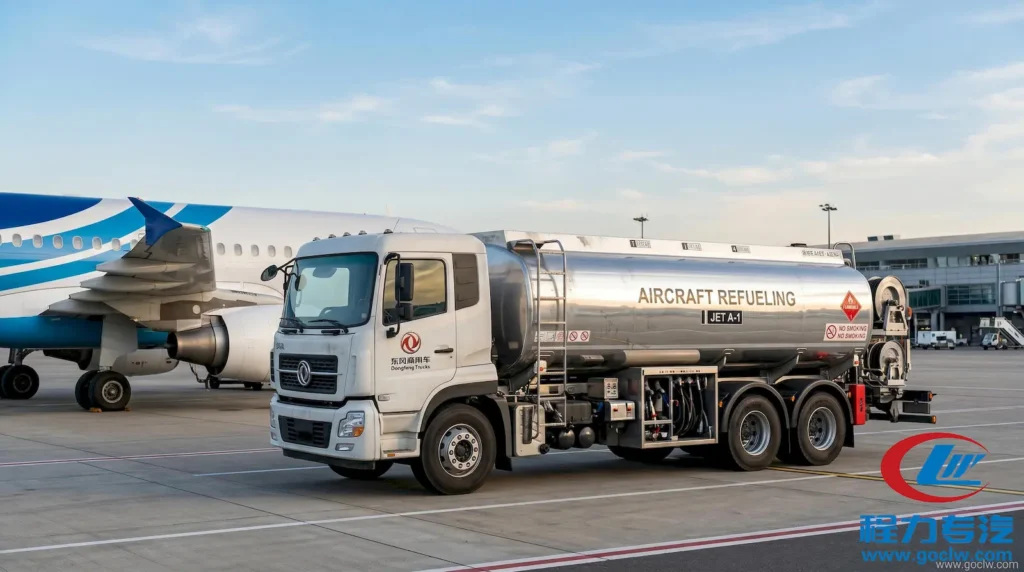
For regional and international airports serving narrow-body aircraft like the Airbus A320 and Boeing 737, the 25CBM aircraft refueling truck has become the workhorse of apron operations. With 25,000 liters of Jet A-1 capacity and dual-mode dispensing, a single unit can fully service one narrow-body departure with fuel to spare — eliminating the back-and-forth that smaller refuelers create during peak hours.
This guide walks airport procurement officers, civil aviation authorities, and ground handling contractors through everything you need to evaluate before issuing an RFQ: real specifications, quality control benchmarks, customization paths, and the questions you should be asking every supplier.
CLW Group has manufactured aviation refuelers for over 20 years and exported special vehicles to 112+ countries. Below is what we’ve learned about specifying the right 25CBM unit for your operation.
Why a 25CBM Aircraft Refueling Truck Is the Right Capacity for Most Regional Airports
Capacity sizing is the single most important decision in any refueler purchase. Too small, and your ground crew makes multiple trips per aircraft. Too large, and you’ve spent capital on payload you’ll never use.
A typical Airbus A320 holds approximately 24,000 liters of usable Jet A-1 fuel; a Boeing 737-800 holds around 26,000 liters. A 25CBM (25,000-liter) refueler hits the sweet spot:
- Single-trip service for most narrow-body departures with no top-up runs
- Faster turnaround times during peak departure windows
- Lower fleet count — one 25CBM unit replaces two smaller 12-15CBM trucks
- Better fuel economy per liter dispensed compared to oversized 40CBM+ units that rarely run full
For airports handling 20-80 narrow-body movements per day, a fleet of two to four 25CBM aircraft refueling trucks typically provides full coverage with one unit always in reserve for maintenance.
25CBM Aircraft Refueling Truck Specifications: Full Parameter Breakdown
The table below shows a representative configuration of the 25CBM aircraft refueling truck CLW manufactures for export markets. Final specifications are tailored to each buyer’s chassis preference, regulatory environment, and apron operating conditions.
| Category | Parameter | Specification |
|---|---|---|
| Tank Capacity | Effective Volume | 25,000 L (25 CBM) |
| Compartments | 1-3 (configurable) | |
| Tank Material | Aluminum alloy 5182 (standard) | |
| Shell Thickness | 5-6 mm | |
| End Plate Thickness | 6-8 mm | |
| Chassis Options | Brand | Dongfeng / Sinotruk HOWO / Shacman / FAW / ISUZU |
| Drive | 6×4 (most common for 25CBM) | |
| Wheelbase | 4,600 mm typical | |
| Engine | Power Output | 290-340 HP (Weichai / Sinotruk MC07) |
| Emission Standard | Euro 3 / Euro 5 / China VI (configurable) | |
| Refueling System | Refueling Mode | Pressure refueling (primary) + Gravity refueling (secondary) |
| Pressure Refueling Flow Rate | 800-1,200 L/min | |
| Gravity Refueling Flow Rate | 300-500 L/min | |
| Flow Meter Accuracy | ±0.2% | |
| Safety Features | Vapor Recovery System | Standard |
| Anti-overflow Probe | Standard | |
| Emergency Cut-off Valve | Standard | |
| Internal Baffles | Standard (multi-chamber) | |
| Dimensions | Overall (L×W×H) | 9,000 × 2,500 × 3,300 mm typical |
| Curb Weight | 9,500-10,500 kg (aluminum tank) | |
| Max Speed | 95 km/h (apron operating speed: ≤30 km/h) |
Chassis & Engine Configuration
The chassis selection drives everything from spare parts availability to operator familiarity in your country. For African and Southeast Asian markets, Sinotruk HOWO and Dongfeng dominate due to wide dealer networks and proven durability in tropical climates. For Latin American buyers, ISUZU chassis are often preferred for parts compatibility with existing fleets.
A 290-340 HP engine paired with a 9-speed manual transmission gives the truck enough torque for fully loaded apron movements and short highway transfers between fuel farm and terminal.
Tank Body Structure & Materials
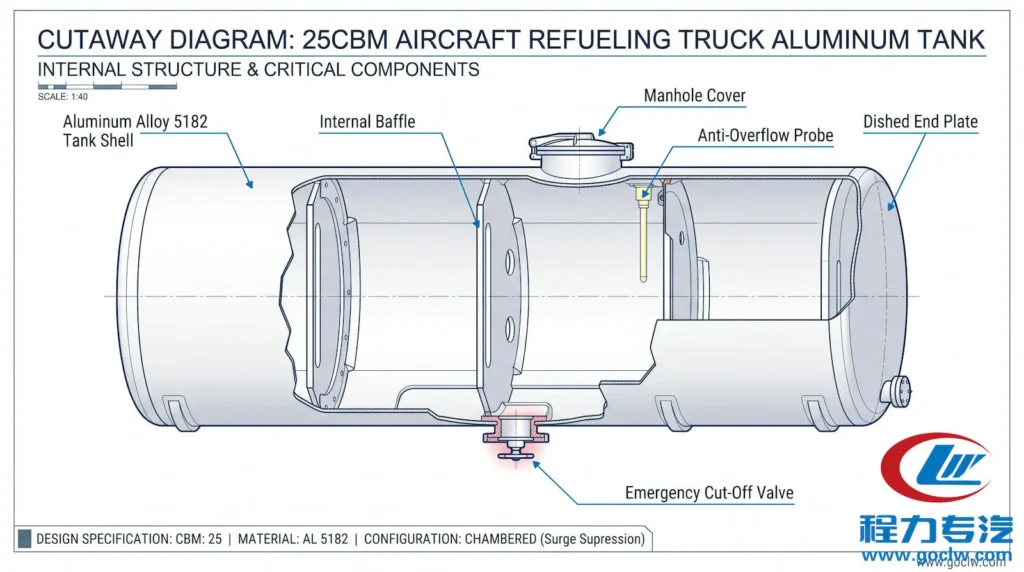
The standard 25CBM tank is constructed from aluminum alloy 5182, the same grade widely specified for international aviation refueler manufacturing. Aluminum offers three significant advantages over alternative materials for aviation fuel service:
- Lighter curb weight — approximately 1,500 kg less than equivalent steel construction, translating to higher payload efficiency and lower fuel consumption per liter dispensed.
- Superior corrosion resistance — aluminum’s natural oxide layer protects against fuel and atmospheric corrosion, extending tank service life in coastal and tropical airport environments.
- Cleaner fuel transport — aluminum surfaces minimize particulate generation inside the tank, helping protect aircraft fuel system integrity.
Shell thickness is 5-6 mm with reinforced 6-8 mm dished end plates. Internal baffles divide the tank into chambers to prevent fuel surge during braking — critical when operating on uneven apron surfaces or during emergency stops.
Refueling System & Flow Performance
The 25CBM aircraft refueling truck is configured with dual refueling modes as standard — pressure refueling for modern commercial aircraft and gravity refueling as a backup or for older aircraft types:
- Pressure refueling: 800-1,200 L/min through underwing single-point connection — the primary mode used by virtually all narrow-body and wide-body commercial aircraft built in the past 30 years.
- Gravity refueling: 300-500 L/min through overwing nozzle — used as backup, for general aviation aircraft, or for fuel topping operations.
- Flow meter accuracy: ±0.2% on the integrated digital flow meter, with printed ticket capability for billing reconciliation.
This dual-mode configuration means a fully loaded 25CBM refueler can dispense its complete payload to a narrow-body aircraft in approximately 21-31 minutes through pressure refueling — well within typical commercial turnaround windows for an A320 or B737. Bottom-loading the truck at the fuel farm typically takes 25-30 minutes.
Quality Assurance: 6-Layer Manufacturing Process from Raw Material to Delivery
Aviation refuelers operate in one of the most safety-sensitive environments on the planet. A weld defect that would be tolerable on a water truck becomes a catastrophic risk when the cargo is Jet A-1. CLW applies a six-stage quality control process to every aircraft refueling truck that leaves the Suizhou facility.
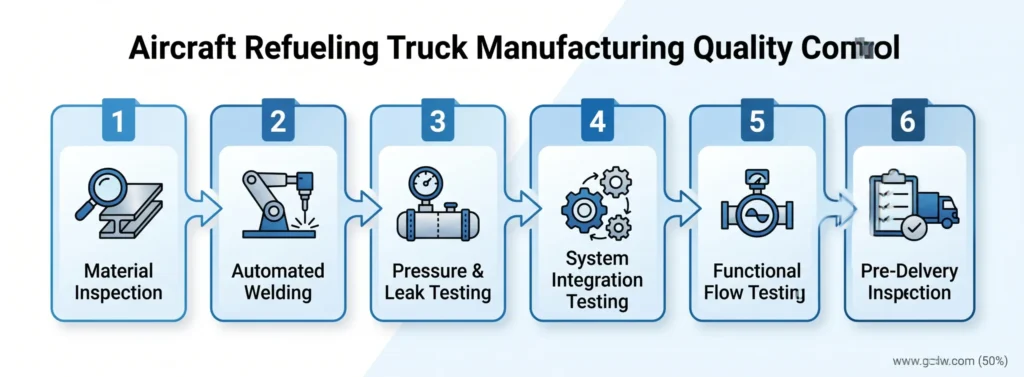
- Material inspection — Every aluminum sheet arrives with mill certificates, then undergoes thickness gauging and surface inspection before cutting.
- Automated welding — Tank seams are welded using automated vertical welding rigs and arc-butt welding for end plates, eliminating the inconsistency of fully manual labor.
- Pressure & leak testing — Every completed tank is hydrostatically pressure-tested and air-leak tested before installation onto the chassis.
- System integration testing — Pumps, flow meters, valves, and filtration systems are bench-tested before installation, then re-tested as a complete system.
- Functional flow testing — Each finished refueler undergoes a full flow test simulating real refueling cycles in both pressure and gravity modes, verifying meter accuracy, dispensing rate, and emergency shut-off response.
- Pre-delivery inspection — A 100% pre-delivery inspection is documented on every unit, with photos and test reports provided to the buyer before shipment.
This is the foundation that allows CLW to back every aircraft refueler with a comprehensive factory warranty and dedicated after-sales support to 112+ export markets.
How a 25CBM Aircraft Refueler Works: 6 Core Subsystems Explained
Understanding how the truck operates helps procurement teams ask better questions during supplier evaluation. Every 25CBM aircraft refueling truck combines six interlocking subsystems:
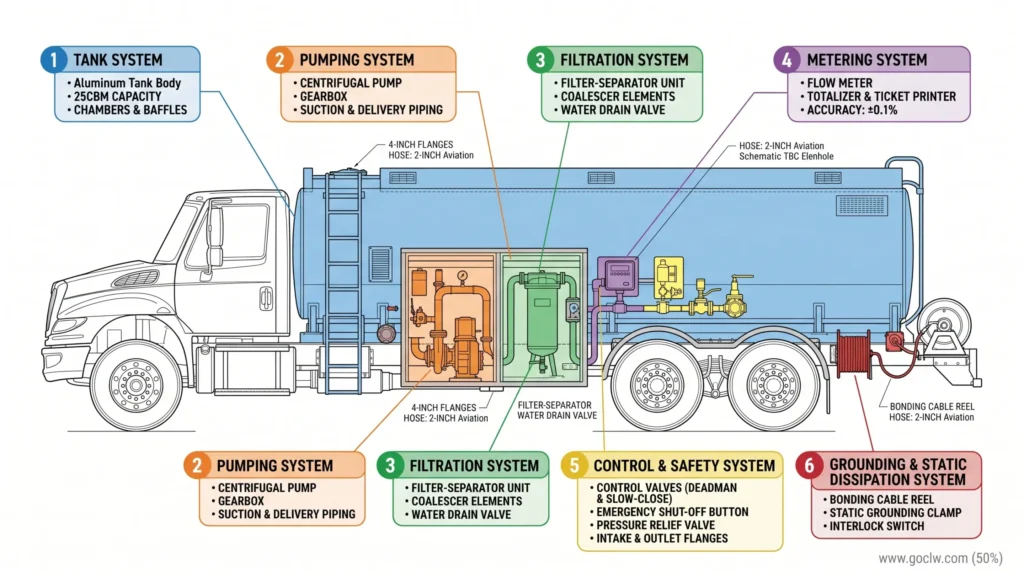
- Tank system — Stores Jet A-1 in baffled aluminum compartments. The dished end plates and reinforced shell handle dynamic loads during transit; the baffles prevent fuel surge during braking.
- Pumping system — A stainless-steel centrifugal pump (powered by a chassis-mounted PTO) generates the pressure needed for high-flow dispensing. Pump output is matched to both pressure refueling and gravity refueling requirements.
- Filtration system — A multi-stage filter-separator removes water and particulate contamination before fuel reaches the aircraft. Filter cartridges are serviceable in the field. Buyers operating in dusty or high-humidity environments often specify upgraded filtration (see customization section below).
- Metering system — A high-precision flow meter (±0.2% accuracy) records every liter dispensed. Modern units integrate digital tickets for billing reconciliation.
- Control & safety system — Emergency shut-off valves at multiple points along the flow path, anti-overflow probes inside the tank, and a deadman handle on the dispensing nozzle ensure that any anomaly stops fuel flow within seconds.
- Grounding & static dissipation system — Dedicated bonding cables connect the truck to the aircraft and to grounding rods on the apron, eliminating static buildup before fuel transfer begins.
Customization Options: Configure Your 25CBM Aircraft Refueling Truck
No two airports are identical, and a serious supplier should configure the truck to your operation rather than ship a stock unit. The most commonly requested customizations on the CLW 25CBM platform include:
| Configuration Area | Standard Option | Available Upgrade |
|---|---|---|
| Tank material | Aluminum alloy 5182 | Stainless steel (for special chemical compatibility) |
| Compartments | Single | 2-3 compartments for multi-grade or multi-customer service |
| Refueling mode | Pressure (primary) + Gravity (secondary) | Pressure-only with HEPCV underwing nozzle for high-throughput operations |
| Hose reels | 1 reel | 2 reels (overwing + underwing combination) |
| Filtration | Standard filter-separator | Parker filtration system (optional, for buyers requiring international filtration standards) |
| Cab | Standard 2-seat | Air-conditioned 3-seat with anti-slip access |
| Emission compliance | Euro 3 | Euro 5 / China VI (where required by import regulation) |
| Drive configuration | 6×4 | 6×6 (for unpaved or semi-prepared airfields) |
| Right-hand / Left-hand drive | LHD | RHD (no surcharge for most markets) |
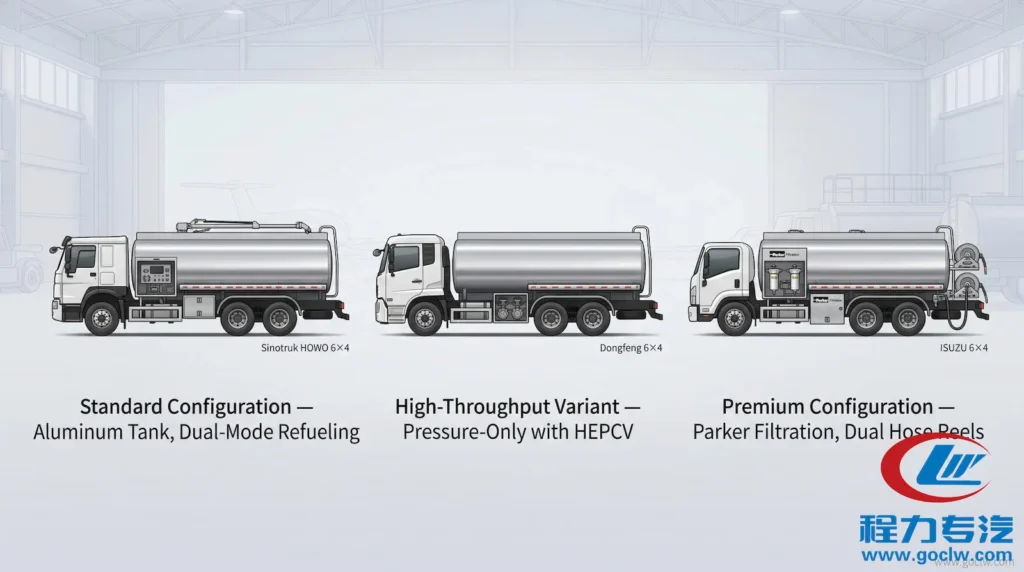
For buyers serving international carriers and requiring elevated fuel cleanliness standards, the Parker filtration upgrade is the most commonly specified option. Browse our complete aviation refueler models catalog to start your specification.
Proven Track Record: Delivering Aircraft Refuelers to Emerging Markets
CLW has delivered aviation refueling equipment to operators across Southeast Asia, South Asia, Africa, and Latin America. One recent project involved a high-capacity aviation refueler delivered to a major Southeast Asian airport in early 2026 — engineered for narrow-body and wide-body aircraft service with a dual pressure-and-gravity dispensing system.
What this experience translates into for buyers:
- 30-day fast delivery for standard 25CBM configurations from the Suizhou production base
- Direct factory pricing — no distributor margin between you and the manufacturer, often delivering 30-50% cost savings versus European or American suppliers
- Customs documentation support — pre-shipment paperwork prepared for your country’s import regulations
- Multi-language operator manuals — English, French, Spanish, Russian, and Arabic available
- On-site commissioning support — engineers can travel to your country to assist with first-unit handover
For procurement teams, this means lower total cost of ownership and faster time-to-service compared to traditional Western suppliers — especially relevant for government civil aviation projects operating under tight budget cycles.
You can see CLW’s full international scope on our about us page, which documents the company’s certifications including ISO and ASME standards as well as the broader manufacturing footprint. Independent international standards organizations such as the International Organization for Standardization (ISO) maintain the quality management frameworks that underpin CLW’s production processes.
Frequently Asked Questions (FAQ)
What is the difference between 25CBM and 30CBM aircraft refueling trucks?
The primary differences are payload capacity, vehicle weight, and chassis configuration. A 25CBM refueler typically uses a 6×4 chassis and weighs around 9,500-10,500 kg empty (with aluminum tank), ideal for narrow-body aircraft service. A 30CBM unit usually requires an 8×4 chassis with a higher gross vehicle weight rating, better suited for wide-body aircraft or higher-traffic hub airports. For most regional and secondary airports, 25CBM provides better operational economics.
How long does a 25CBM aircraft refueler take to refuel an A320 or B737?
Through pressure refueling at 800-1,200 L/min — the standard mode for modern commercial aircraft — dispensing 25,000 liters takes approximately 21-31 minutes. This fits comfortably within the typical 30-40 minute ground turnaround window for an A320 or B737. Through gravity refueling at 300-500 L/min, the same payload takes 50-83 minutes, which is why pressure refueling is the preferred mode for commercial operations. Bottom-loading the truck at the fuel farm typically takes 25-30 minutes.
What aviation fuels can a 25CBM refueler handle?
The standard configuration handles Jet A-1, the global standard kerosene-based aviation fuel used by virtually all commercial turbine aircraft. Optional configurations support Jet A (used primarily in the Americas), AVTUR (Russian-spec military equivalent), and JP-8 (NATO military spec). Avgas (for piston aircraft) requires a different tank material specification and should be ordered as a separate variant.
What is the typical lead time for ordering a 25CBM aircraft refueling truck?
Standard configurations ship in approximately 30 days from order confirmation. Highly customized units — such as those requiring Parker filtration, pressure-only HEPCV configurations, or special chassis brands — typically take 45-60 days. Sea freight to most destinations adds another 25-45 days depending on routing.
Get a Custom Quote for Your 25CBM Aircraft Refueling Truck
Specifying the right aviation refueler is too important for stock-photo catalogs and fixed price lists. Every airport operates differently — apron layout, climate, fuel grade, traffic mix, regulatory environment.
Send us your operating profile and we’ll prepare a configured quote within 24 hours, including chassis options, customization pricing, lead time, and delivered cost to your nearest port.
Contact Alvin, Export Director at CLW Group:
- WhatsApp: +86 18371886000
- Email: [email protected]
- Web: www.goclw.com
CLW has delivered special vehicles to 112+ countries with 20+ years of manufacturing expertise. Let our 8,000+ skilled employees and 38 specialized workshops serve your project — direct from factory, with no intermediaries.